Before becoming Lisbon’s monumental waterfront square, Praça do Comércio was known as Terreiro do Paço, the political and ceremonial heart of the Portuguese kingdom. From the late 16th century until the mid-18th century, this open space was one of the principal stages for autos-da-fé, the public rituals organized by the Portuguese Inquisition to pronounce sentences against those accused of heresy.
These ceremonies were not marginal events. They were carefully choreographed spectacles involving royal authorities, ecclesiastical institutions, and large crowds. Their public nature was intentional: punishment, confession, and reconciliation were transformed into instruments of collective instruction and fear.
For New Christians, many of them of Jewish origin or descendants of forcibly converted Jews, the Terreiro do Paço became a space of exposure and humiliation, where private belief was violently transformed into public accusation.
The Ritual of the Auto-da-fé
An auto-da-fé typically unfolded over several stages. Prisoners were brought from inquisitorial jails to the square, often wearing penitential garments such as the sanbenito, marked with symbols indicating their alleged crimes. Sermons were preached, sentences were read aloud, and distinctions were made between those “reconciled” to the Church and those handed over to secular authorities for execution.
While executions often took place outside the city walls, the Terreiro do Paço was where the social verdict was delivered. The square functioned as a theater of power, binding religious orthodoxy to royal authority in the most visible urban setting of Lisbon.
Jewish History and the Inquisition in Lisbon
For the Jewish and converso population, the autos-da-fé held at Terreiro do Paço were a constant reminder of surveillance and vulnerability. Families could see relatives publicly accused; entire social networks were destabilized. Even those not directly prosecuted lived under the pressure of denunciation, confiscation of property, and social exclusion.
This site thus forms part of the broader geography of persecution in Lisbon, connecting inquisitorial prisons, confiscated houses, forced migrations, and exile routes that extended far beyond Portugal.
Transformation of the Space
The devastating earthquake of 1755 destroyed much of the Ribeira Palace that framed the Terreiro do Paço. In its reconstruction, the square was reimagined as Praça do Comércio, symbol of mercantile power and imperial renewal. This transformation physically erased many architectural traces of the inquisitorial past, but not its historical weight.
Today, the square is associated with openness, light, and the Tagus River. Yet beneath its rational Pombaline design lies the memory of a space where justice was staged as spectacle and intolerance was normalized through ritual.
Cabo Ruivo Seaplane Base
Opened as a seaplane gateway on the Tagus waterfront, Cabo Ruivo was Lisbon’s “river airport” in the era of long-range flying boats. Pan American established a provisional base here in 1938, and the site became a strategic point for intercontinental air travel, especially during the Second World War, when Lisbon functioned as an entry and escape corridor in neutral Portugal.
The first scheduled commercial passenger flight arrived on 29 June 1939, when Pan Am’s Boeing 314 “Dixie Clipper” reached Cabo Ruivo after departing Port Washington, New York, continuing onward toward Marseille as part of the transatlantic route.
Built context and location
In 1942, the Portuguese government decided to create a proper air-marine base and structured the airport around the Doca dos Olivais. To link the seaplane airport with the land airport at Portela, a major road connection was built, originally called Avenida Entre-os-Aeroportos, today Avenida de Berlim.
Wartime threshold: what can, and cannot, be counted
A precise number of “refugees who entered by plane” is difficult to establish from the published record because most statistics refer to total passenger traffic rather than refugee status.
What can be quantified is the scale of the air-sea entry channel. A detailed study of Lisbon’s wartime travel economy records that, by the end of 1939, more than thirty-nine transatlantic flying boats had already brought 643 passengers to Cabo Ruivo, and that in the six following years another 16,000 passengers still used this means of transport to disembark in Lisbon. These figures describe passengers, not exclusively refugees, but they define the order of magnitude of the route that included refugee travel.
Refugee entry and stories tied to the Clipper route
Contemporary historical writing describes Pan American’s Clipper service as an emblematic escape vehicle for those who could afford it, a “luxurious seaplane” flying twice weekly between Lisbon and New York during the war years.
Photographic documentation from the period, held in archives and community collections, records Cabo Ruivo as a waterfront threshold of wartime mobility: arrivals and departures by flying boat, passengers with luggage and documents, uniforms and ground crews, waiting areas, and the choreography of transit along the Tagus, in an airport that no longer functions as an airport but remains identifiable as a place.
Critical event: the Yankee Clipper crash (1943)
Cabo Ruivo’s history also includes disaster. On 22 February 1943, Pan Am’s Boeing 314 “Yankee Clipper” crashed while attempting to land on the River Tagus in Lisbon, killing 24 of the 39 people on board, with 15 survivors recorded in accident documentation.
Afterlife of the site
As land-based aviation became dominant after the war, the flying-boat era ended. Cabo Ruivo’s seaplane operations were discontinued in the late 1950s (often given as 1958/59), and the waterfront area was later reshaped through major redevelopment associated with Expo ’98 and today’s Parque das Nações.
Cozinha Económica Israelita
Founded in 1899 as a Jewish charitable institution, the Cozinha Económica Israelita became one of Lisbon’s most important community-run relief services, especially during the refugee crisis of the Second World War.
By the late 1910s, it was operating in Travessa do Noronha, a short dead-end lane just below Rua da Escola Politécnica and near Jardim do Príncipe Real, an urban setting that would later become strongly associated with wartime transit, hunger, paperwork, and survival.
Institutional context
Because the Jewish community in Lisbon faced long periods without full legal recognition, communal life was often consolidated through autonomous benevolent institutions. In the official historical narrative of the Comunidade Israelita de Lisboa (CIL), the Cozinha Económica appears alongside other key welfare initiatives as a foundational pillar of organized Jewish life in modern Lisbon.
During the Second World War, this support network expanded dramatically. Financed through international Jewish aid, including the American Joint Distribution Committee, the community maintained the Cozinha Económica and other services, distributing food, clothing, and medical support to refugees in transit through Portugal.
The Travessa do Noronha complex
Contemporary reporting identifies a small institutional cluster in Travessa do Noronha: the soup kitchen at no. 17, a Jewish hospital at no. 19, and a shelter or albergue at no. 21.
This was not only a social service address, it was a micro-geography of wartime Lisbon. Refugees, aid workers, and state surveillance all intersected here, and the street entered later memory as a place where daily subsistence and bureaucratic uncertainty were lived side by side.
Material object with a biography: meal tickets
One of the most revealing material traces of the Cozinha Económica is the meal-ticket system. Refugees who needed to eat there received senhas de refeição, a practical mechanism that turned communal aid into an organized, trackable routine.
A surviving example, reproduced in press coverage, is a meal ticket issued in the name of the child refugee Benjamin Schlesinger, linking the institution to specific lives and family trajectories, not only to abstract numbers.
Scale of assistance
Sources describe the Cozinha Económica as providing hundreds of meals per day and as part of a wider effort that supported thousands of Jewish refugees passing through Portugal during the war years.
A decisive rupture: sale, demolition, and disappearance
After the postwar period, the physical site did not remain intact. Reporting based on community testimony states that the CIL sold the Travessa do Noronha buildings in 1959 or 1960, after which the original structures were demolished and replaced by later developments. The area saw further demolition again in 2019 in the context of new real-estate projects.
A contemporary gesture of memory
To mark and honor this historic site in the urban fabric, the Centro Cultural Rua da Judiaria already has a Stolperschwellen prepared to be installed on the pavement in front of the building, creating a visible, permanent point of remembrance for the Cozinha Económica Israelita and the lives sustained here. The installation is planned for 2026.
Jewish Inscriptions in the Carmo Museum
The Jewish inscriptions preserved in the Museu Arqueológico do Carmo form one of the most important groups of Hebrew epigraphy in Portugal. The museum was founded in 1864 by the Associação dos Arqueólogos Portugueses and is installed in the ruins of the former Carmo Church, in central Lisbon. Within its collection, the key Jewish pieces are two funerary stelae from Espiche, near Lagos, and the monumental inscription from the former Synagogue of Monchique, in Porto.
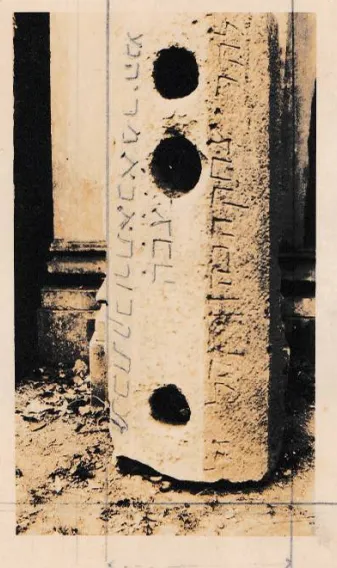
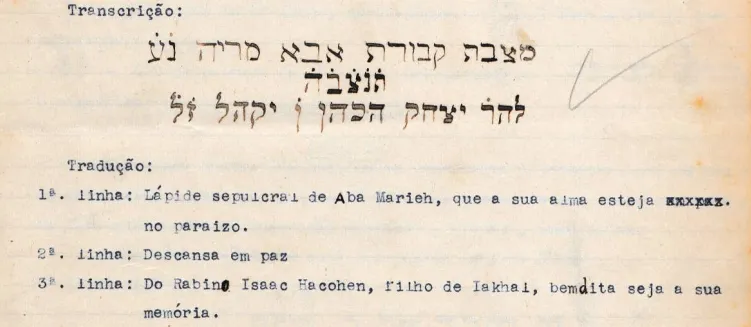
Espiche Stele, Aba Marieh and Rabbi Isaac HaCohen
Catalogue no. 3877. Provenance: Espiche, near Lagos. Entered the museum in 1874.
Biblioteca Samuel SchwarzBiblioteca Samuel Schwarz
This is a prismatic funerary stele with inscriptions on three faces. It records two burials at different moments: Aba Marieh and Rabbi Isaac HaCohen, son of Iakhai. The text preserves standard Hebrew funerary formulas and shows that the same stone was reused for two individuals. It is one of the clearest Jewish funerary inscriptions from medieval Portugal preserved in a museum collection.
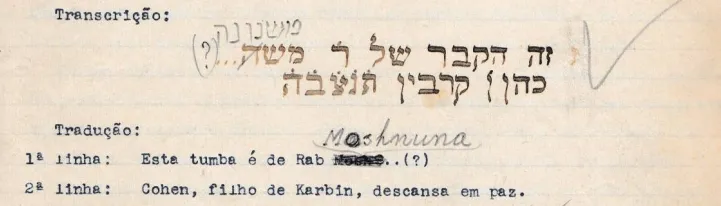
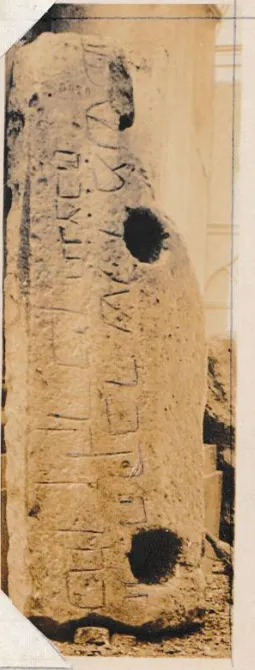
Espiche Stele, Rab Moshe and Cohen son of Karbin
Catalogue no. 3878. Provenance: Espiche, near Lagos. Entered the museum in 1874.
Biblioteca Samuel SchwarzBiblioteca Samuel Schwarz
This second Espiche stone is also funerary. It is a prismatic stele with a damaged inscription, which makes the reading incomplete. The surviving text refers to a rabbi whose name begins with Moshe and to a Cohen, son of Karbin, followed by a funerary formula. Even in its damaged state, the stone remains an important witness to Hebrew burial epigraphy in the Algarve.
Monchique Synagogue Inscription
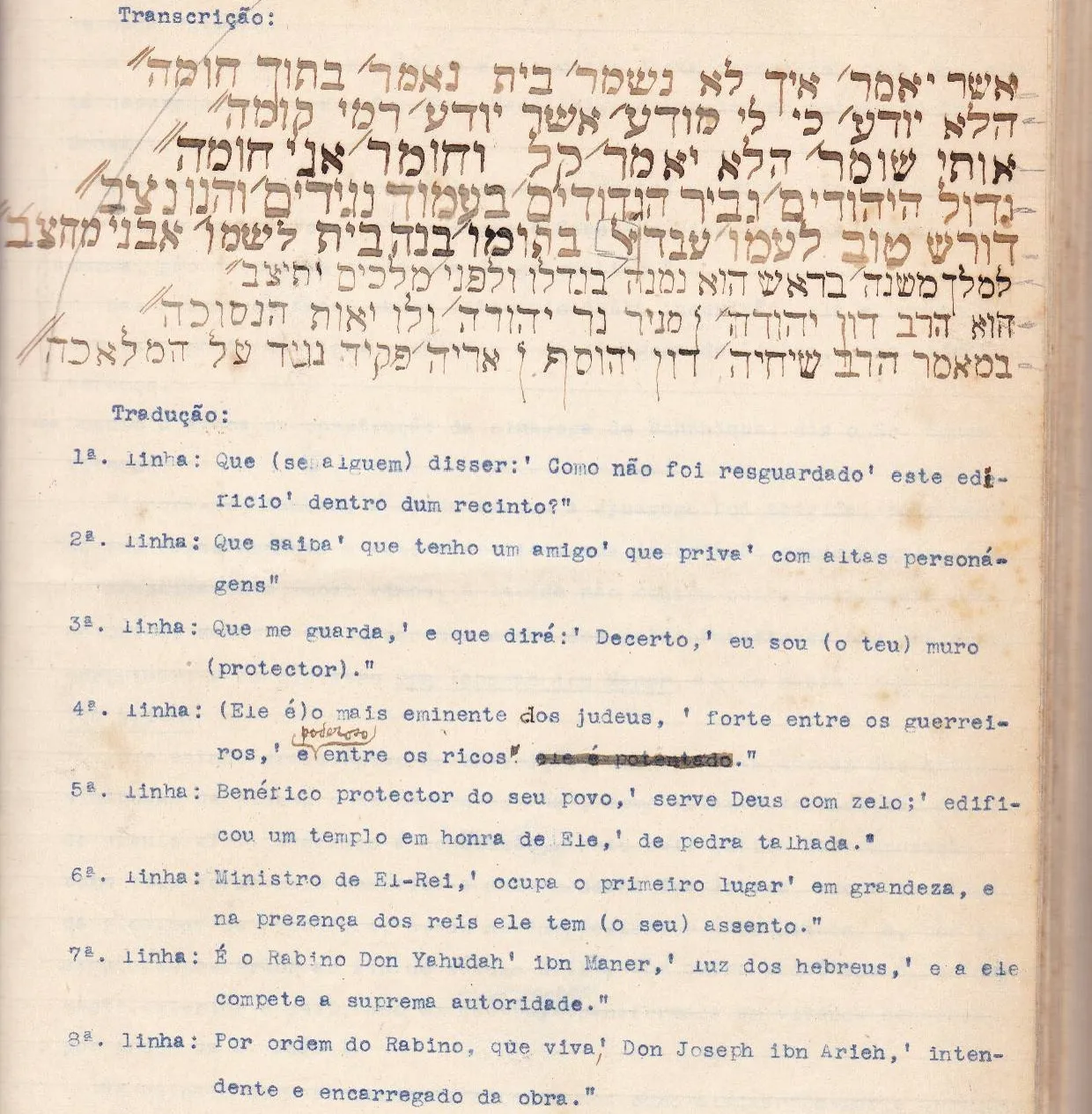
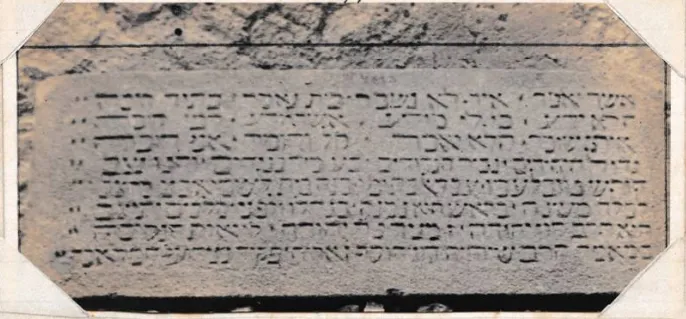
Catalogue no. 2313. Provenance: former Synagogue of Monchique, Porto. Transferred to the museum on 3 February 1875. Material: granite. Dimensions: 1.54 m x 0.63 m.
Biblioteca Samuel SchwarzBiblioteca Samuel Schwarz
This is the most important Jewish inscription in the Carmo Museum. Unlike the Espiche stones, it is not funerary but communal. It comes from the former Synagogue of Monchique in Porto and preserves a commemorative synagogue text. Its significance lies in the fact that it is a rare surviving inscription directly connected to medieval Jewish institutional life in Portugal.