Near São Bartolomeu de Messines, in the surroundings of Silves, a marble plaque bearing a Hebrew inscription was identified during the excavation of a Roman villa in the area of Cortes. The stone preserves the name Yehiel, followed by additional letters that have not yet been fully deciphered. Based on its form and content, archaeologists have proposed that it is a funerary inscription.
Within the same debris layer in which the plaque was found, red deer antlers were recovered and radiocarbon dated to around 390 CE. This dating places the inscription at least prior to that moment. The find is now cited as one of the earliest archaeological pieces associated with Jewish presence in the southwestern Iberian Peninsula, within a rural Roman context.
Hebrew Inscription
The Hebrew inscription of Braga is one of the rarest material traces of medieval Jewish presence in the city. It consists of a small Hebrew carving made up of only three letters, engraved on a granite voussoir reused within a Gothic arch preserved inside the building historically known as Casa Grande, the former District Hostel, located on Rua de Santo António das Travessas, within the area of the Judiaria Nova.
The inscription was identified in March 1981 by historian Eduardo Pires de Oliveira during works carried out in the building and later examined by several scholars. The letters, written in square Hebrew script, are alef, tav, and he (א ת ה). Due to its extreme brevity, the inscription’s exact meaning remains uncertain. Scholarly analysis raises a key question: whether the stone was carved for that specific location or reused from an earlier architectural context, a hypothesis considered likely.
Despite these uncertainties, the inscription is widely regarded as medieval and not a modern forgery. Its importance lies precisely in its modest scale and its urban context. While it does not conclusively identify the location of a synagogue, it stands as a rare epigraphic trace of Jewish life in Braga and strengthens the historical identification of the Judiaria Nova on Rua de Santo António das Travessas.
This fragment exemplifies how Jewish history in Portugal often survives through minimal physical traces, demanding careful reading, interpretative restraint, and respect for material evidence.
Jewish Inscriptions in the Carmo Museum
The Jewish inscriptions preserved in the Museu Arqueológico do Carmo form one of the most important groups of Hebrew epigraphy in Portugal. The museum was founded in 1864 by the Associação dos Arqueólogos Portugueses and is installed in the ruins of the former Carmo Church, in central Lisbon. Within its collection, the key Jewish pieces are two funerary stelae from Espiche, near Lagos, and the monumental inscription from the former Synagogue of Monchique, in Porto.
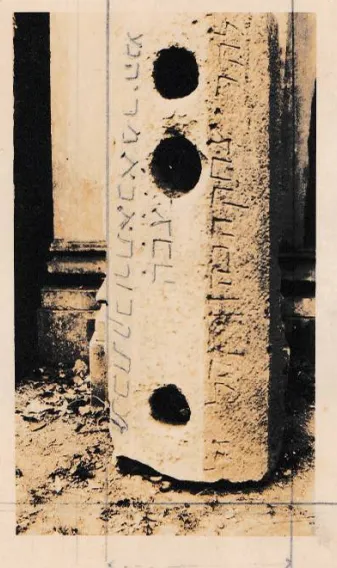
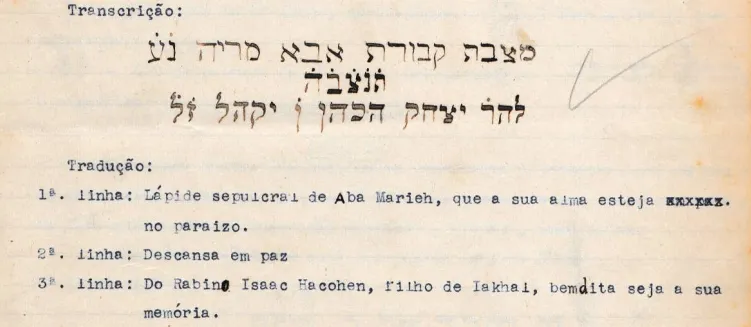
Espiche Stele, Aba Marieh and Rabbi Isaac HaCohen
Catalogue no. 3877. Provenance: Espiche, near Lagos. Entered the museum in 1874.
Biblioteca Samuel SchwarzBiblioteca Samuel Schwarz
This is a prismatic funerary stele with inscriptions on three faces. It records two burials at different moments: Aba Marieh and Rabbi Isaac HaCohen, son of Iakhai. The text preserves standard Hebrew funerary formulas and shows that the same stone was reused for two individuals. It is one of the clearest Jewish funerary inscriptions from medieval Portugal preserved in a museum collection.
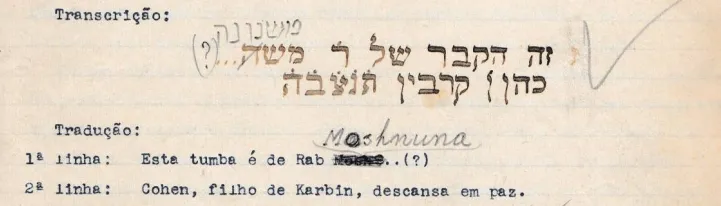
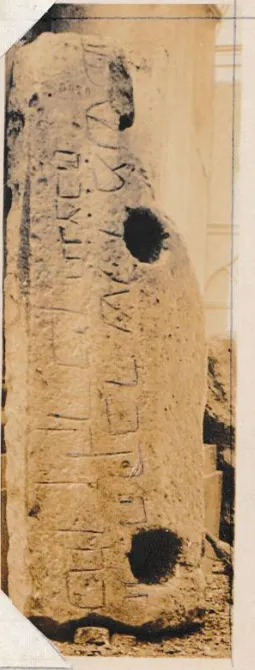
Espiche Stele, Rab Moshe and Cohen son of Karbin
Catalogue no. 3878. Provenance: Espiche, near Lagos. Entered the museum in 1874.
Biblioteca Samuel SchwarzBiblioteca Samuel Schwarz
This second Espiche stone is also funerary. It is a prismatic stele with a damaged inscription, which makes the reading incomplete. The surviving text refers to a rabbi whose name begins with Moshe and to a Cohen, son of Karbin, followed by a funerary formula. Even in its damaged state, the stone remains an important witness to Hebrew burial epigraphy in the Algarve.
Monchique Synagogue Inscription
Catalogue no. 2313. Provenance: former Synagogue of Monchique, Porto. Transferred to the museum on 3 February 1875. Material: granite. Dimensions: 1.54 m x 0.63 m.
Biblioteca Samuel SchwarzBiblioteca Samuel Schwarz
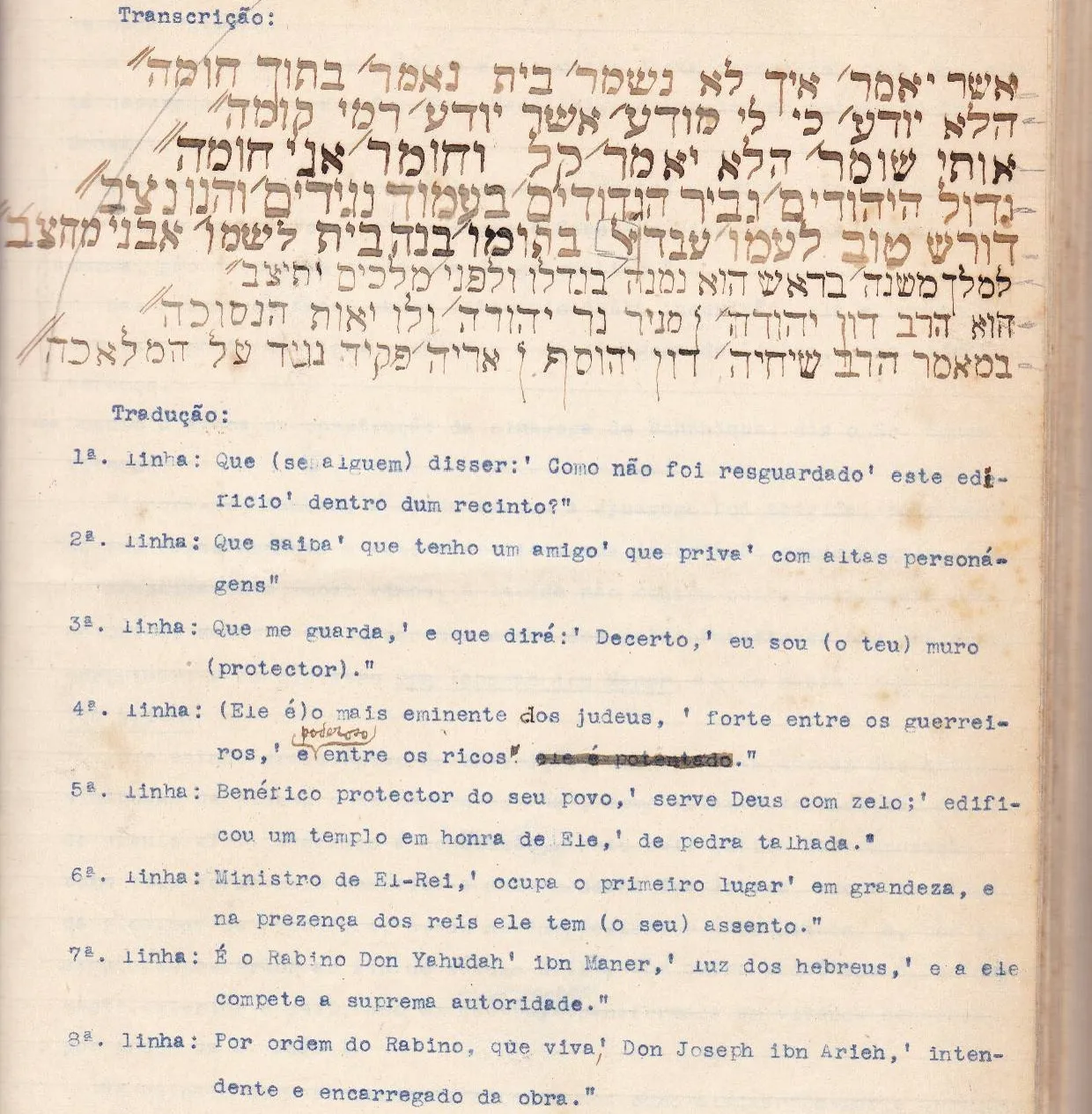
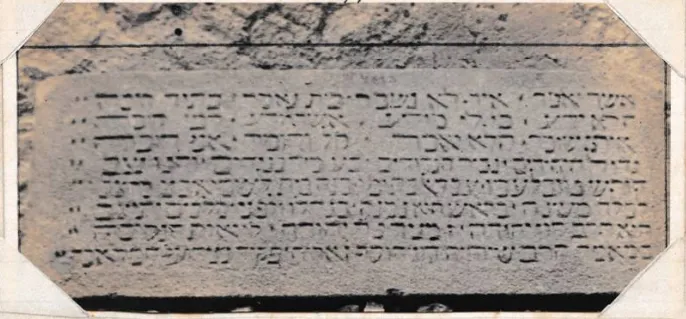
This is the most important Jewish inscription in the Carmo Museum. Unlike the Espiche stones, it is not funerary but communal. It comes from the former Synagogue of Monchique in Porto and preserves a commemorative synagogue text. Its significance lies in the fact that it is a rare surviving inscription directly connected to medieval Jewish institutional life in Portugal.