Inside Lisbon’s National Pantheon, the name of Aristides de Sousa Mendes is marked through a commemorative plaque that functions as a symbolic tomb. It is a deliberately sober form of remembrance, integrated into a monument dedicated to honoring Portuguese figures whose lives are understood as part of the country’s civic and moral legacy.
Aristides de Sousa Mendes served as Portugal’s consul in Bordeaux and, in June 1940, as the Nazi advance pushed tens of thousands of refugees toward the last open routes out of France, he issued visas on a massive scale, in direct defiance of restrictive orders from the Salazar regime. Among those who received these documents were many Jews. For countless families, the Portuguese visa was the decisive bridge to Portugal and, from there, to onward escape by sea or air.
The Pantheon tribute acknowledges both the concrete act of rescue and its cost. Sousa Mendes was disciplined, ruined professionally, and marginalized for choosing conscience over obedience. Decades later, international recognition helped reshape his public memory, including his designation by Yad Vashem as Righteous Among the Nations. Portugal’s decision to grant him Honours of the National Pantheon formalized that reappraisal at the highest symbolic level, placing his story within Lisbon’s principal architecture of national commemoration.
The memorial can be visited within the Pantheon’s interior spaces, where the plaque anchors an “absent presence”, an empty tomb that insists on the ethical weight of one person’s decision, and links Lisbon’s landscape of memory to the wartime passage of refugees who crossed the city in search of safety.
Vhils WWII Refugee Mural
Vhils’ WWII Refugee Mural in Lisbon was installed in 2023 near the Rocha Conde de Óbidos Maritime Terminal, in connection with the 136th anniversary of the Port of Lisbon and with efforts to recall Lisbon’s role as a point of departure for refugees escaping Europe during the Second World War, many of them Jews.
The mural is based on a wartime photograph by Roger Kahan, a French Jewish refugee and photographer who passed through Lisbon in 1940. Rather than inventing a symbolic image from scratch, Vhils reworked a documented refugee scene connected to the port itself. The image chosen shows a refugee beside a post box before departure, and the mural was placed next to that same surviving post box at Rocha Conde de Óbidos.
Its importance lies in the precision of that connection between image and place. The mural fixes refugee memory in the exact port landscape through which these departures took place, using an image made by someone who was himself part of that history.
Hannah Arendt Memorial
The Hannah Arendt Memorial in Lisbon takes the form of a small ground intervention rather than a conventional monument. Inaugurated on 10 December 2018, International Human Rights Day, it was installed at the corner of Rua da Sociedade Farmacêutica and Rua Conde de Redondo, close to the address most often associated with Arendt’s stay in the city, Rua da Sociedade Farmacêutica 6B. The proposal came from the LIVRE party in the Lisbon Municipal Assembly, was approved unanimously, and was then implemented by the city’s cultural department.
Hannah Arendt in Lisbon
The memorial marks a precise moment in Hannah Arendt’s life. A German Jewish philosopher and refugee from Nazism, she was in Lisbon between January and May 1941, together with her husband Heinrich Blücher and her mother, while waiting for the documents and passage that would allow them to leave for the United States. Her stay lasted about three and a half months, during the period when Lisbon served as one of the main Atlantic routes of escape from occupied Europe.
Form and Location
The memorial is deliberately discreet. Rather than a statue designed to dominate the square, it consists of two inscribed bands set into two low steps in the pavement. One records Arendt’s presence in Lisbon as a refugee from the Nazi regime. The other carries a quotation connected to her reflections on refugees and exile. Its placement at ground level matters because it turns an ordinary street corner into a place of reading and memory without separating it from the city’s daily movement.
Historical Significance
What gives the memorial its force is its precision. It links Hannah Arendt to a specific address, a specific crossing of streets, and a specific historical moment in which refugees in Lisbon waited for visas, ships, and permission to begin again. In this case, the memorial does not monumentalize Arendt in the abstract. It ties her directly to Lisbon’s wartime history as a transit city of exile and escape.
Memorial to the Victims of the 1506 Jewish Massacre
Installed in 2008 in the square facing the Church of São Domingos, this memorial marks the site associated with the outbreak of the Lisbon massacre of April 1506 and stands today as one of the city’s most direct public statements on anti-Jewish violence and the fragility of civic order.
The memorial was created by Graça Bachmann, following suggestions and a proposal connected to the Jewish community, and was inaugurated in a public ceremony that brought together municipal authorities and representatives of different faiths.
Formally, the work is a truncated stone sphere, described in official cultural listings as a “world” cut open, a deliberate image of rupture, violence, and chaos. In the plane of that cut, a Magen David is carved out and filled with an inscription that anchors the memorial in place, time, and meaning.
Inside the Star of David, the Portuguese text remembers “the thousands of Jews” who were victims of intolerance and religious fanaticism, murdered in the massacre that began on 19 April 1506 “in this square”. The dates appear both in the Gregorian calendar (1506–2006) and in the Hebrew years (5266–5766), explicitly linking Lisbon’s local trauma to a Jewish chronology of memory.
At the base, on the rectangular stone plinth supporting the sculpture, a Hebrew inscription quotes the Book of Job, traditionally identified as Job 16:18, a short sentence that refuses erasure: “O earth, do not hide my blood, do not hide my cry.” This detail is crucial because it turns the monument into more than a marker, it makes it a moral demand, inscribed at street level, in a place of daily passage.
The event remembered here began in late April 1506 amid crisis, fear, and religious agitation. Contemporary and later accounts describe how violence spread through the city and targeted the so-called “New Christians”, Jews forcibly converted in Portugal, and those suspected of judaizing. Modern scholarship commonly places the death toll somewhere between roughly 1,000 and 4,000 people.
The memorial also sits within a broader institutional landscape of public memory in this square. Next to it, another monument and related initiatives were presented as gestures of remembrance and reconciliation, showing how Largo de São Domingos has become a concentrated urban site where Lisbon narrates a difficult chapter of its own history.
Jewish Inscriptions in the Carmo Museum
The Jewish inscriptions preserved in the Museu Arqueológico do Carmo form one of the most important groups of Hebrew epigraphy in Portugal. The museum was founded in 1864 by the Associação dos Arqueólogos Portugueses and is installed in the ruins of the former Carmo Church, in central Lisbon. Within its collection, the key Jewish pieces are two funerary stelae from Espiche, near Lagos, and the monumental inscription from the former Synagogue of Monchique, in Porto.
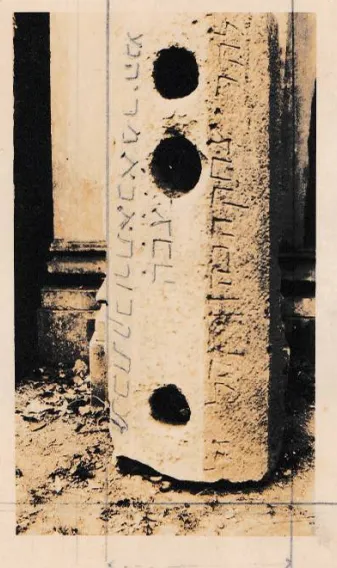
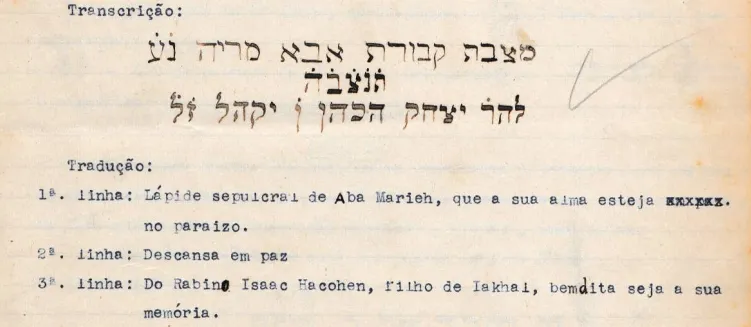
Espiche Stele, Aba Marieh and Rabbi Isaac HaCohen
Catalogue no. 3877. Provenance: Espiche, near Lagos. Entered the museum in 1874.
Biblioteca Samuel SchwarzBiblioteca Samuel Schwarz
This is a prismatic funerary stele with inscriptions on three faces. It records two burials at different moments: Aba Marieh and Rabbi Isaac HaCohen, son of Iakhai. The text preserves standard Hebrew funerary formulas and shows that the same stone was reused for two individuals. It is one of the clearest Jewish funerary inscriptions from medieval Portugal preserved in a museum collection.
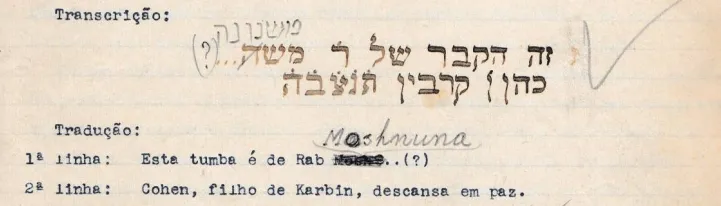
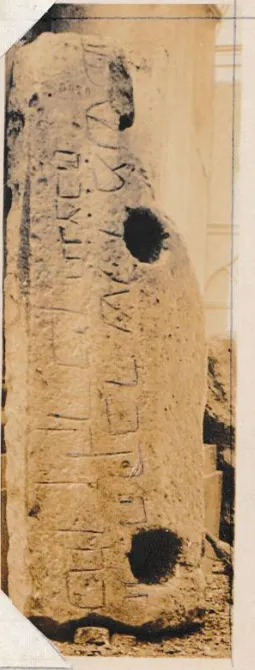
Espiche Stele, Rab Moshe and Cohen son of Karbin
Catalogue no. 3878. Provenance: Espiche, near Lagos. Entered the museum in 1874.
Biblioteca Samuel SchwarzBiblioteca Samuel Schwarz
This second Espiche stone is also funerary. It is a prismatic stele with a damaged inscription, which makes the reading incomplete. The surviving text refers to a rabbi whose name begins with Moshe and to a Cohen, son of Karbin, followed by a funerary formula. Even in its damaged state, the stone remains an important witness to Hebrew burial epigraphy in the Algarve.
Monchique Synagogue Inscription
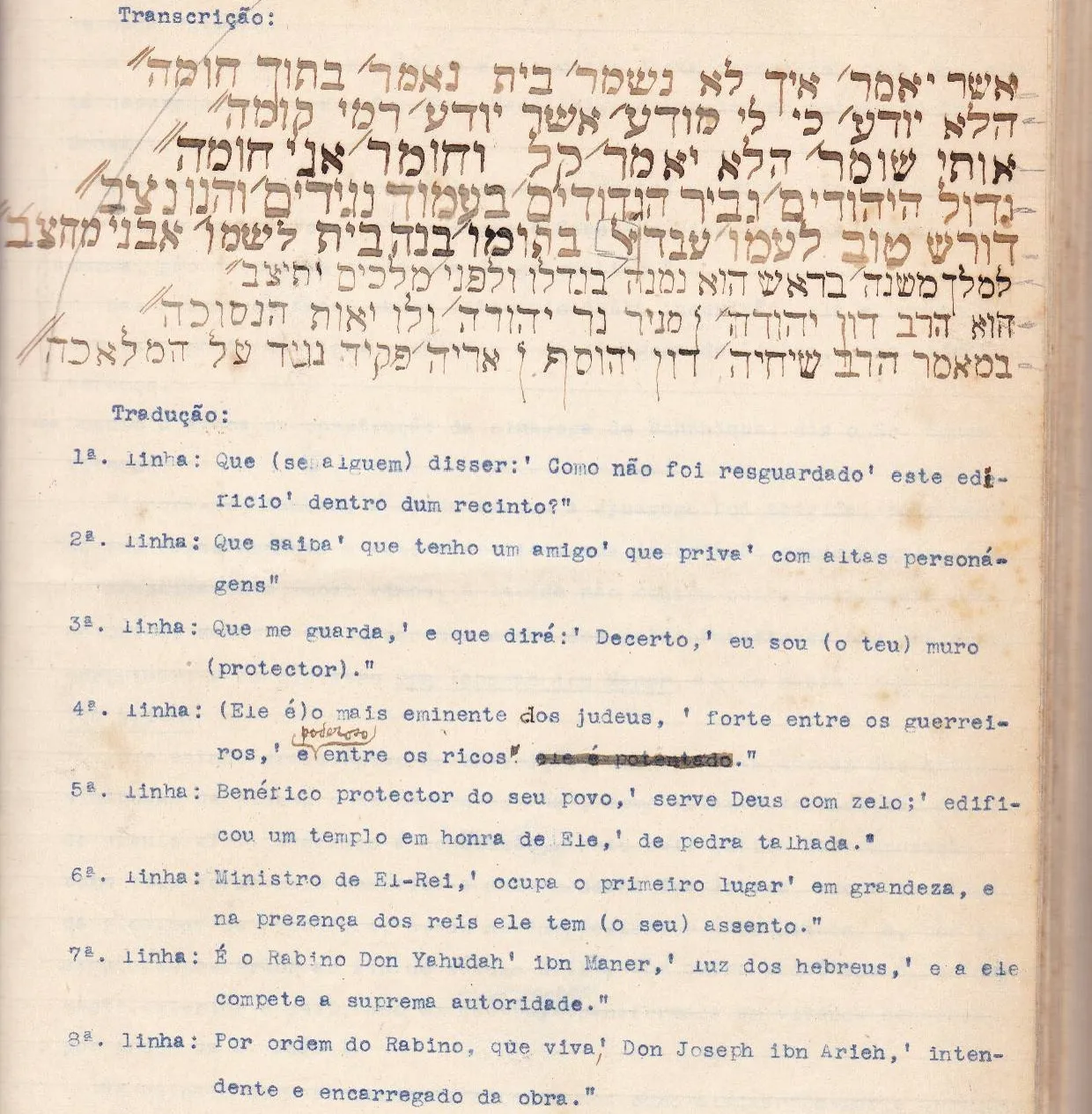
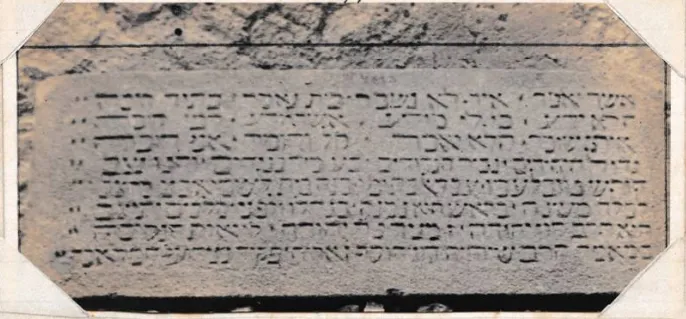
Catalogue no. 2313. Provenance: former Synagogue of Monchique, Porto. Transferred to the museum on 3 February 1875. Material: granite. Dimensions: 1.54 m x 0.63 m.
Biblioteca Samuel SchwarzBiblioteca Samuel Schwarz
This is the most important Jewish inscription in the Carmo Museum. Unlike the Espiche stones, it is not funerary but communal. It comes from the former Synagogue of Monchique in Porto and preserves a commemorative synagogue text. Its significance lies in the fact that it is a rare surviving inscription directly connected to medieval Jewish institutional life in Portugal.
Lisbon Synagogue Shaaré Tikvá
Inaugurated on May 18, 1904, the Lisbon Synagogue, known as Shaaré Tikvá (Gates of Hope), is the principal synagogue in Lisbon and the first synagogue built from scratch in Portugal since the forced conversions and the official extinction of Portuguese Judaism at the end of the 15th century.
The building was the result of a long communal effort to move from modest, improvised houses of prayer to a purpose-built temple. Community records mention several prayer spaces operating in private houses from at least 1810, and they situate the long path toward institutional consolidation in the 19th century, including efforts to unify different congregational groups and services.
A decisive organizational step came in 1897, with the “Inaugural Session of the Israeli Committee of Lisbon” (Comité Israelita de Lisboa), chaired by Leão Amzalak and led by figures such as Simão Anahory and Abraham Bensaúde. A commission for the construction of a single synagogue was created, aiming to serve the whole community.
The architectural project was commissioned to Miguel Ventura Terra, one of the most prominent Portuguese architects of his time. The synagogue was built at no. 59 Rua Alexandre Herculano, but not as a street-facing monument. Portuguese law then restricted non-Catholic temples from having a façade directly visible from the public road, so the building was constructed inside a walled courtyard, accessed through a gate to the street, a spatial solution that became part of its identity.
In plan and ritual orientation, Shaaré Tikvá follows a rectangular, symmetrical layout and faces Jerusalem. Heritage and tourism descriptions often emphasize its austere and eclectic language, combining historicist references and frequently described as drawing on Roman, Byzantine, and Romantic vocabularies.
The construction process itself is unusually well documented in communal memory. The cornerstone was laid on May 25, 1902, and the work proceeded under the direction of Abílio Pereira de Campos. The inauguration in 1904 gathered the Jewish community of Lisbon and included the Rabbi of Gibraltar, Moisés Benazim.
The building’s 20th-century life included significant transformation. The synagogue’s records describe restoration works and a major expansion directed by architect Carlos Ramos in 1948; other heritage summaries place this intervention in 1948–1949, reflecting a wider postwar phase of repair and enlargement.
A second decisive cycle came in the early 2000s. The synagogue has been classified as a Property of Public Interest (Imóvel de Interesse Público) since 2002. Around the centenary, extensive restoration and improvement works were carried out between 2002 and 2004, including changes to the boundary wall and updates to interior color and lighting, under architects João Seabra and Ricardo Gordon, with support from Portuguese state bodies, Lisbon City Council, and community-linked donors.
One heritage moment highlighted in the synagogue’s own narrative was the centenary commemoration held on September 9, 2004, attended by Israel’s Sephardic Chief Rabbi Shlomo Moshe Amar, the President of Portugal Jorge Sampaio, and representatives of other faith communities.
From a heritage perspective, Shaaré Tikvá is a document of modern Jewish reappearance in Lisbon, not only through its ritual life but also through its architecture of constrained visibility, a synagogue intentionally set back from the street. Its classification as Imóvel de Interesse Público places it within Portugal’s protected built heritage framework.
Ohel Jacob Synagogue
Founded in 1934, the Ohel Jacob Synagogue is Lisbon’s only Ashkenazi synagogue and, today, a Progressive (Reform) congregation linked to the Hehaver Community. Located on the upper floor of a residential building, it represents a different kind of Jewish landmark, intimate in scale and shaped by migration, refuge, and the rebuilding of Jewish life in Portugal.
The synagogue grew out of the Association of Israelite Youth Hehaver, founded in 1925 in a context of renewed religious freedom in the early Portuguese Republic. The first communal meetings began in Hehaver premises, and the synagogue was established by a small group of Ashkenazi Jews from Central Europe, many of them Polish. From its beginnings, Ohel Jacob developed a reputation for openness, especially toward Jews of diverse backgrounds and toward descendants of Portuguese anusim, also known as b’nei anusim.
Architecturally, Ohel Jacob is defined by its setting and scale. Reached by stairs to the second floor, the synagogue occupies an adapted apartment plan. The sanctuary is organized around a clear axis between the bimah and the Aron Hakodesh. In recent renovation phases, the community also reorganized its internal spaces, including the transfer of its small museum collection to one of the larger rooms within the apartment.
Ohel Jacob’s identity is inseparable from its people and its institutional memory. The community records its early leadership, including Samuel Sorin as the synagogue’s first leader in 1934. In the 21st century, Ohel Jacob formalized its links with Progressive Judaism through affiliation with the European Union for Progressive Judaism and the World Union for Progressive Judaism.
One material detail often stays with visitors: the synagogue’s Torah scroll collection, associated by the community with Jewish refugees from Nazi Europe, includes a fragment linked to survival during Kristallnacht. In parallel, the community has documented efforts to rehabilitate and preserve its Torah scrolls so they can remain in active ritual use, not only as objects of memory.
From a heritage perspective, Ohel Jacob matters precisely because it is not a showpiece building. It is a living record of Lisbon as a place of arrival, refuge, and religious reconstruction. Its modest setting, its role in welcoming b’nei anusim, and its continued ritual life make it a key reference point for understanding modern Jewish presence in Portugal.