The statue of Francisco Sanches, installed in 1954 in Largo de São João do Souto, was designed by the sculptor Salvador Barata Feyo and placed directly opposite the church where Sanches was baptized in 1551. That location is not incidental. It anchors the monument to the most concrete documented point in his early life and ties Braga’s urban memory to a figure born into a family of New Christian origin.
Francisco Sanches became one of the most important physicians and philosophers of the Iberian Renaissance. His best-known work, Quod nihil scitur (1581), challenged scholastic certainty and helped secure his place in the history of European skepticism. He later built his career mainly in France, especially in Toulouse, where he taught and practiced medicine.
The monument therefore does more than commemorate a local intellectual. It marks, in public space, the memory of a thinker whose life was shaped by the difficult world of families of Jewish descent in early modern Iberia, and whose work reached far beyond Braga. In this case, the statue connects the city not only to Jewish memory, but also to the wider histories of medicine, philosophy, and critical thought.
Hebrew Inscription
The Hebrew inscription of Braga is one of the rarest material traces of medieval Jewish presence in the city. It consists of a small Hebrew carving made up of only three letters, engraved on a granite voussoir reused within a Gothic arch preserved inside the building historically known as Casa Grande, the former District Hostel, located on Rua de Santo António das Travessas, within the area of the Judiaria Nova.
The inscription was identified in March 1981 by historian Eduardo Pires de Oliveira during works carried out in the building and later examined by several scholars. The letters, written in square Hebrew script, are alef, tav, and he (א ת ה). Due to its extreme brevity, the inscription’s exact meaning remains uncertain. Scholarly analysis raises a key question: whether the stone was carved for that specific location or reused from an earlier architectural context, a hypothesis considered likely.
Despite these uncertainties, the inscription is widely regarded as medieval and not a modern forgery. Its importance lies precisely in its modest scale and its urban context. While it does not conclusively identify the location of a synagogue, it stands as a rare epigraphic trace of Jewish life in Braga and strengthens the historical identification of the Judiaria Nova on Rua de Santo António das Travessas.
This fragment exemplifies how Jewish history in Portugal often survives through minimal physical traces, demanding careful reading, interpretative restraint, and respect for material evidence.
Carlos Sampaio Garrido Memorial
Set beside the busy artery of Avenida Almirante Reis, near the Metro stop Anjos, a discreet plaque at Largo de Santa Bárbara anchors one of Lisbon’s most consequential connections to the history of the Holocaust. The memorial honours Carlos Sampaio Garrido (1883–1960), the Portuguese diplomat who served in Hungary during the war years and is widely credited with helping to save around a thousand Hungarian Jews in 1944, at a moment when deportations and persecution accelerated with brutal speed.
The plaque’s location is not incidental. It stands in the immediate orbit of Rua dos Anjos 79, the headquarters of the Lisbon Regional Council of the Portuguese Bar Association (Ordem dos Advogados), a venue that hosted public commemorations connected to International Holocaust Remembrance Day. In January 2012, these initiatives combined an exhibition, public talks, and the unveiling of this very memorial, weaving together civic space, institutional memory, and the ethical questions raised by rescue, neutrality, and individual responsibility under dictatorship and occupation.
What the monument is
The monument takes the form of a commemorative plaque with a direct, didactic inscription. It identifies Sampaio Garrido as Portugal’s ambassador in Budapest (1939–44), explicitly links him to the title “Righteous Among the Nations,” and frames the tribute as recognition “for saving from death Jews persecuted during the Holocaust.” It is dated to Lisbon, 27 January 2012, marking International Holocaust Remembrance Day, and includes institutional references associated with Holocaust education and remembrance in Portugal.
This is a memorial designed less for ceremony than for encounter. It is not monumental in scale, but it is unambiguous in message: the city’s streets can also be archives, and a life of moral risk can be made legible in public space without spectacle.
Historical context
Carlos Sampaio Garrido was Portugal’s representative in Hungary during the period when Nazi policy, local collaboration, and wartime chaos converged into mass persecution. In early April 1944, as anti-Jewish measures intensified, he warned Lisbon through diplomatic channels about the degrading and predatory nature of the decrees being imposed on Hungarian Jews. Soon after, amid wartime disruptions and the relocation of some diplomatic missions, he moved the Portuguese legation’s operations and his residence outside Budapest and sheltered a group of Hungarian citizens, most of them Jewish, seeking to protect them from imminent danger.
On 28 April 1944, Hungarian political police raided the ambassador’s residence at dawn. According to testimony cited by Yad Vashem, Garrido physically tried to block the removal of one of the people under his protection, insisting on the inviolability of diplomatic premises. Despite his efforts, the raid proceeded and his “guests” were taken back to Budapest. He continued to press for their release, filed formal complaints, and demanded accountability. In the aftermath, Hungarian authorities declared him persona non grata, and only then did he inform Lisbon of the identities of those he had sheltered.
The scale of rescue associated with Portuguese action in Budapest during 1944 is often discussed as collective and contingent, involving Garrido and other diplomats and officials operating under severe constraints. A Portuguese official publication summarizing these efforts states that the combined action of Sampaio Garrido, Alberto Teixeira Branquinho, and Jules Gulden, with some degree of coverage from the Portuguese government, saved about a thousand Jews.
Recognition and memory in Lisbon
In 2010, Yad Vashem recognized Carlos Sampaio Garrido as Righteous Among the Nations, a designation reserved for non-Jews who risked their lives to save Jews during the Holocaust without expectation of reward.
Two years later, in January 2012, Lisbon’s local institutions translated that recognition into a public memorial. The Lisbon Regional Council of the Portuguese Bar Association partnered with the local parish authority (at the time, Junta de Freguesia dos Anjos) in a program of events that included the exhibition Vidas Poupadas: A Acção de Três Diplomatas Portugueses na II Guerra Mundial at Rua dos Anjos 79, followed by the unveiling of a plaque in his honour at Largo de Santa Bárbara.
The same commemorative cycle brought together diplomats, elected officials, and civil society figures connected to Holocaust memory in Portugal, indicating how Sampaio Garrido’s story moved from archival and family recollection into a shared public narrative.
Why this place matters in a Jewish heritage itinerary
Lisbon is often remembered as a wartime transit city, but this memorial points to another dimension of the city’s relationship to Jewish history: the diplomatic and bureaucratic channels through which lives could be protected or abandoned. The plaque at Largo de Santa Bárbara condenses that moral geography into a single point. It is a marker of a Portuguese presence inside the Holocaust’s European epicentre, and a reminder that, even within restrictive political systems, individual decisions could open narrow corridors of survival.
In the context of Jewish heritage, this is not a site of medieval continuity or synagogue architecture. It is a site of twentieth-century ethical memory, where the language of civic honour meets the history of rescue, persecution, and the afterlives of testimony.
Aristides Sousa Mendes Memorial
Inside Lisbon’s National Pantheon, the name of Aristides de Sousa Mendes is marked through a commemorative plaque that functions as a symbolic tomb. It is a deliberately sober form of remembrance, integrated into a monument dedicated to honoring Portuguese figures whose lives are understood as part of the country’s civic and moral legacy.
Aristides de Sousa Mendes served as Portugal’s consul in Bordeaux and, in June 1940, as the Nazi advance pushed tens of thousands of refugees toward the last open routes out of France, he issued visas on a massive scale, in direct defiance of restrictive orders from the Salazar regime. Among those who received these documents were many Jews. For countless families, the Portuguese visa was the decisive bridge to Portugal and, from there, to onward escape by sea or air.
The Pantheon tribute acknowledges both the concrete act of rescue and its cost. Sousa Mendes was disciplined, ruined professionally, and marginalized for choosing conscience over obedience. Decades later, international recognition helped reshape his public memory, including his designation by Yad Vashem as Righteous Among the Nations. Portugal’s decision to grant him Honours of the National Pantheon formalized that reappraisal at the highest symbolic level, placing his story within Lisbon’s principal architecture of national commemoration.
The memorial can be visited within the Pantheon’s interior spaces, where the plaque anchors an “absent presence”, an empty tomb that insists on the ethical weight of one person’s decision, and links Lisbon’s landscape of memory to the wartime passage of refugees who crossed the city in search of safety.
Autos-da-Fé at Praça do Comércio
Before becoming Lisbon’s monumental waterfront square, Praça do Comércio was known as Terreiro do Paço, the political and ceremonial heart of the Portuguese kingdom. From the late 16th century until the mid-18th century, this open space was one of the principal stages for autos-da-fé, the public rituals organized by the Portuguese Inquisition to pronounce sentences against those accused of heresy.
These ceremonies were not marginal events. They were carefully choreographed spectacles involving royal authorities, ecclesiastical institutions, and large crowds. Their public nature was intentional: punishment, confession, and reconciliation were transformed into instruments of collective instruction and fear.
For New Christians, many of them of Jewish origin or descendants of forcibly converted Jews, the Terreiro do Paço became a space of exposure and humiliation, where private belief was violently transformed into public accusation.
The Ritual of the Auto-da-fé
An auto-da-fé typically unfolded over several stages. Prisoners were brought from inquisitorial jails to the square, often wearing penitential garments such as the sanbenito, marked with symbols indicating their alleged crimes. Sermons were preached, sentences were read aloud, and distinctions were made between those “reconciled” to the Church and those handed over to secular authorities for execution.
While executions often took place outside the city walls, the Terreiro do Paço was where the social verdict was delivered. The square functioned as a theater of power, binding religious orthodoxy to royal authority in the most visible urban setting of Lisbon.
Jewish History and the Inquisition in Lisbon
For the Jewish and converso population, the autos-da-fé held at Terreiro do Paço were a constant reminder of surveillance and vulnerability. Families could see relatives publicly accused; entire social networks were destabilized. Even those not directly prosecuted lived under the pressure of denunciation, confiscation of property, and social exclusion.
This site thus forms part of the broader geography of persecution in Lisbon, connecting inquisitorial prisons, confiscated houses, forced migrations, and exile routes that extended far beyond Portugal.
Transformation of the Space
The devastating earthquake of 1755 destroyed much of the Ribeira Palace that framed the Terreiro do Paço. In its reconstruction, the square was reimagined as Praça do Comércio, symbol of mercantile power and imperial renewal. This transformation physically erased many architectural traces of the inquisitorial past, but not its historical weight.
Today, the square is associated with openness, light, and the Tagus River. Yet beneath its rational Pombaline design lies the memory of a space where justice was staged as spectacle and intolerance was normalized through ritual.
Vhils WWII Refugee Mural
Vhils’ WWII Refugee Mural in Lisbon was installed in 2023 near the Rocha Conde de Óbidos Maritime Terminal, in connection with the 136th anniversary of the Port of Lisbon and with efforts to recall Lisbon’s role as a point of departure for refugees escaping Europe during the Second World War, many of them Jews.
The mural is based on a wartime photograph by Roger Kahan, a French Jewish refugee and photographer who passed through Lisbon in 1940. Rather than inventing a symbolic image from scratch, Vhils reworked a documented refugee scene connected to the port itself. The image chosen shows a refugee beside a post box before departure, and the mural was placed next to that same surviving post box at Rocha Conde de Óbidos.
Its importance lies in the precision of that connection between image and place. The mural fixes refugee memory in the exact port landscape through which these departures took place, using an image made by someone who was himself part of that history.
Hannah Arendt Memorial
The Hannah Arendt Memorial in Lisbon takes the form of a small ground intervention rather than a conventional monument. Inaugurated on 10 December 2018, International Human Rights Day, it was installed at the corner of Rua da Sociedade Farmacêutica and Rua Conde de Redondo, close to the address most often associated with Arendt’s stay in the city, Rua da Sociedade Farmacêutica 6B. The proposal came from the LIVRE party in the Lisbon Municipal Assembly, was approved unanimously, and was then implemented by the city’s cultural department.
Hannah Arendt in Lisbon
The memorial marks a precise moment in Hannah Arendt’s life. A German Jewish philosopher and refugee from Nazism, she was in Lisbon between January and May 1941, together with her husband Heinrich Blücher and her mother, while waiting for the documents and passage that would allow them to leave for the United States. Her stay lasted about three and a half months, during the period when Lisbon served as one of the main Atlantic routes of escape from occupied Europe.
Form and Location
The memorial is deliberately discreet. Rather than a statue designed to dominate the square, it consists of two inscribed bands set into two low steps in the pavement. One records Arendt’s presence in Lisbon as a refugee from the Nazi regime. The other carries a quotation connected to her reflections on refugees and exile. Its placement at ground level matters because it turns an ordinary street corner into a place of reading and memory without separating it from the city’s daily movement.
Historical Significance
What gives the memorial its force is its precision. It links Hannah Arendt to a specific address, a specific crossing of streets, and a specific historical moment in which refugees in Lisbon waited for visas, ships, and permission to begin again. In this case, the memorial does not monumentalize Arendt in the abstract. It ties her directly to Lisbon’s wartime history as a transit city of exile and escape.
Memorial to the Victims of the 1506 Jewish Massacre
Installed in 2008 in the square facing the Church of São Domingos, this memorial marks the site associated with the outbreak of the Lisbon massacre of April 1506 and stands today as one of the city’s most direct public statements on anti-Jewish violence and the fragility of civic order.
The memorial was created by Graça Bachmann, following suggestions and a proposal connected to the Jewish community, and was inaugurated in a public ceremony that brought together municipal authorities and representatives of different faiths.
Formally, the work is a truncated stone sphere, described in official cultural listings as a “world” cut open, a deliberate image of rupture, violence, and chaos. In the plane of that cut, a Magen David is carved out and filled with an inscription that anchors the memorial in place, time, and meaning.
Inside the Star of David, the Portuguese text remembers “the thousands of Jews” who were victims of intolerance and religious fanaticism, murdered in the massacre that began on 19 April 1506 “in this square”. The dates appear both in the Gregorian calendar (1506–2006) and in the Hebrew years (5266–5766), explicitly linking Lisbon’s local trauma to a Jewish chronology of memory.
At the base, on the rectangular stone plinth supporting the sculpture, a Hebrew inscription quotes the Book of Job, traditionally identified as Job 16:18, a short sentence that refuses erasure: “O earth, do not hide my blood, do not hide my cry.” This detail is crucial because it turns the monument into more than a marker, it makes it a moral demand, inscribed at street level, in a place of daily passage.
The event remembered here began in late April 1506 amid crisis, fear, and religious agitation. Contemporary and later accounts describe how violence spread through the city and targeted the so-called “New Christians”, Jews forcibly converted in Portugal, and those suspected of judaizing. Modern scholarship commonly places the death toll somewhere between roughly 1,000 and 4,000 people.
The memorial also sits within a broader institutional landscape of public memory in this square. Next to it, another monument and related initiatives were presented as gestures of remembrance and reconciliation, showing how Largo de São Domingos has become a concentrated urban site where Lisbon narrates a difficult chapter of its own history.
Jewish Inscriptions in the Carmo Museum
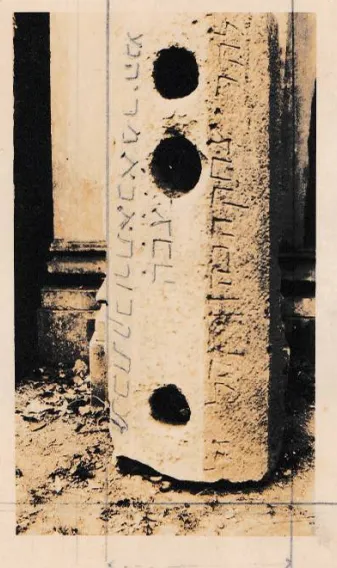
The Jewish inscriptions preserved in the Museu Arqueológico do Carmo form one of the most important groups of Hebrew epigraphy in Portugal. The museum was founded in 1864 by the Associação dos Arqueólogos Portugueses and is installed in the ruins of the former Carmo Church, in central Lisbon. Within its collection, the key Jewish pieces are two funerary stelae from Espiche, near Lagos, and the monumental inscription from the former Synagogue of Monchique, in Porto.
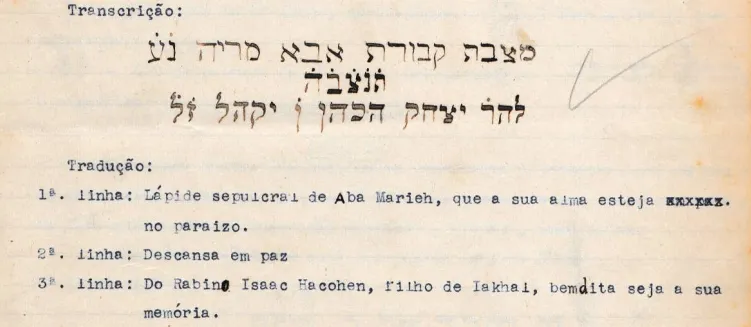
Espiche Stele, Aba Marieh and Rabbi Isaac HaCohen
Catalogue no. 3877. Provenance: Espiche, near Lagos. Entered the museum in 1874.
Biblioteca Samuel SchwarzBiblioteca Samuel Schwarz
This is a prismatic funerary stele with inscriptions on three faces. It records two burials at different moments: Aba Marieh and Rabbi Isaac HaCohen, son of Iakhai. The text preserves standard Hebrew funerary formulas and shows that the same stone was reused for two individuals. It is one of the clearest Jewish funerary inscriptions from medieval Portugal preserved in a museum collection.
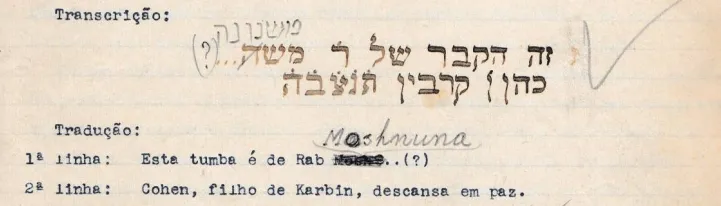
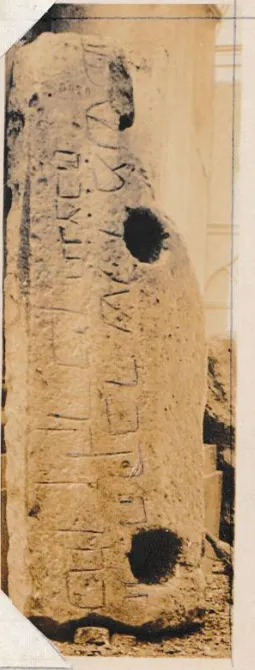
Espiche Stele, Rab Moshe and Cohen son of Karbin
Catalogue no. 3878. Provenance: Espiche, near Lagos. Entered the museum in 1874.
Biblioteca Samuel SchwarzBiblioteca Samuel Schwarz
This second Espiche stone is also funerary. It is a prismatic stele with a damaged inscription, which makes the reading incomplete. The surviving text refers to a rabbi whose name begins with Moshe and to a Cohen, son of Karbin, followed by a funerary formula. Even in its damaged state, the stone remains an important witness to Hebrew burial epigraphy in the Algarve.
Monchique Synagogue Inscription
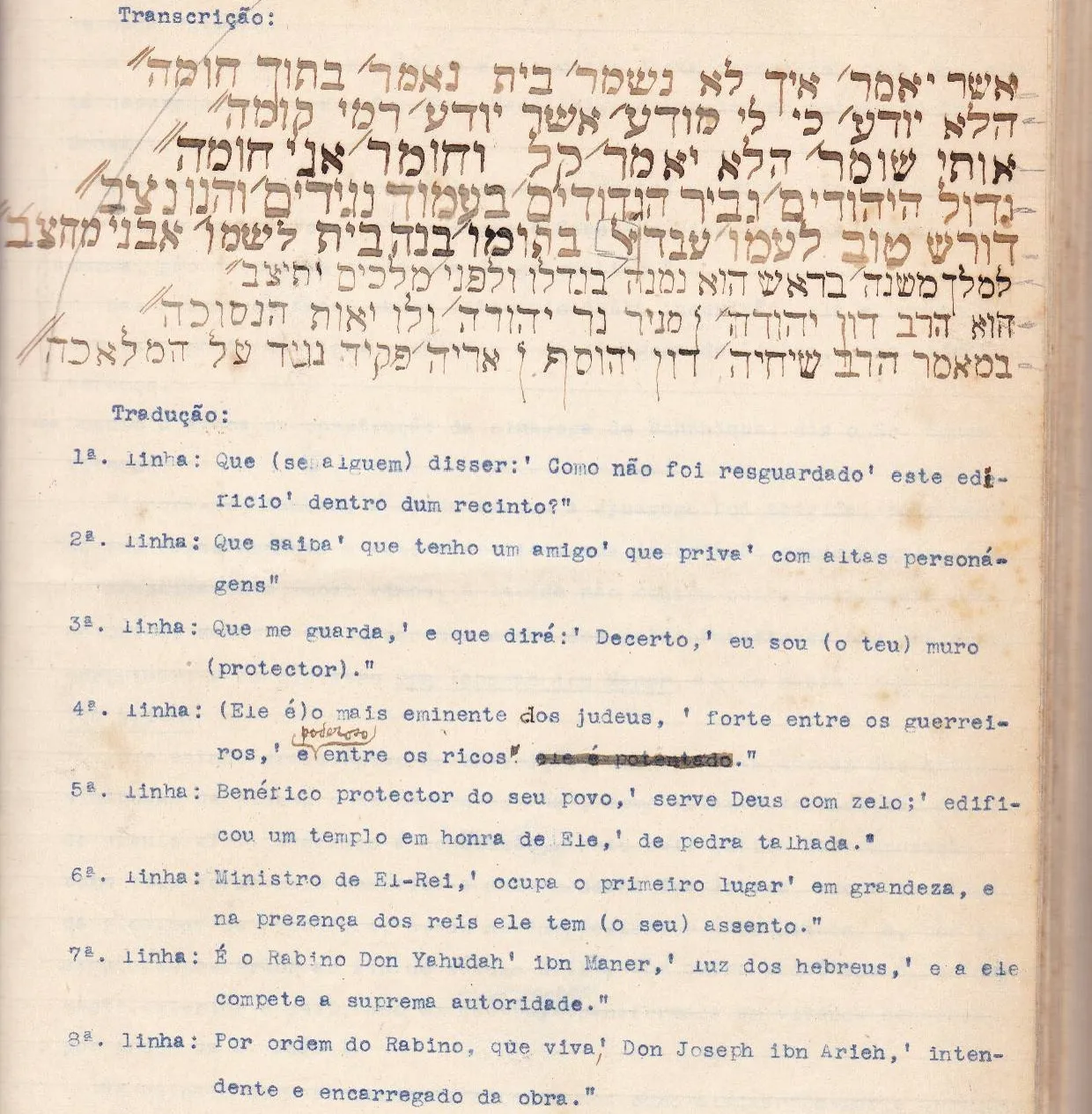
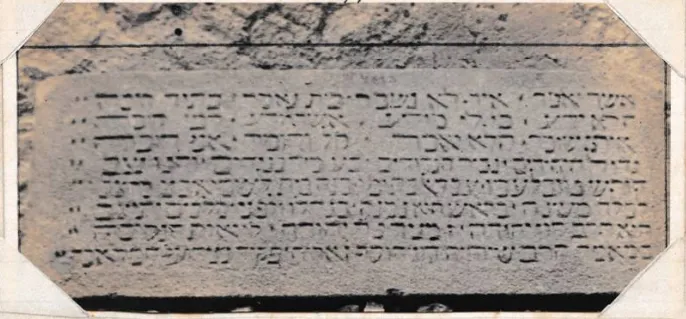
Catalogue no. 2313. Provenance: former Synagogue of Monchique, Porto. Transferred to the museum on 3 February 1875. Material: granite. Dimensions: 1.54 m x 0.63 m.
Biblioteca Samuel SchwarzBiblioteca Samuel Schwarz
This is the most important Jewish inscription in the Carmo Museum. Unlike the Espiche stones, it is not funerary but communal. It comes from the former Synagogue of Monchique in Porto and preserves a commemorative synagogue text. Its significance lies in the fact that it is a rare surviving inscription directly connected to medieval Jewish institutional life in Portugal.
Lisbon Israeli Cemetery
Lisbon’s main active Jewish cemetery is located on Rua Afonso III, in the area historically linked to Calçada das Lages. It stands as a key landmark in the reconstitution of Jewish communal life in the city during the 19th century, when small groups of Jews began settling in Portugal again, even before the official abolition of the Inquisition in 1821.
According to the Lisbon Jewish Community’s own records, in 1868 King Luís granted “the Jews of Lisbon permission to establish a cemetery for the burial of their fellow Jews.” This authorization formalized Calçada das Lages (today associated with Afonso III) as the community’s central burial ground, a document of both religious continuity and the gradual public reappearance of Jewish life in Lisbon.
The cemetery’s history is closely linked to communal organization. In 1892, the Civil Government charter ratified the statutes of the Guemilut Hassadim Association, founded by Moses Anahory, responsible for mutual aid and funerals. The association managed burials, oversaw the two cemeteries, and kept the death registers, ensuring that Jewish burial practice and documentation remained organized across generations.
This site also connects to an earlier chapter of modern Jewish Lisbon. A small Jewish plot was obtained in the Estrela cemetery area in 1801, and the first recorded grave there was José Amzalaga, who died on February 26, 1804. That earlier plot served the community until the mid 19th century, when the Calçada das Lages cemetery became the principal active cemetery.