

The Judiaria de Trancoso was one of the most important Jewish quarters of the Beira Interior in the late Middle Ages. The Jewish presence in Trancoso is documented from at least the fourteenth century and became especially significant in the fifteenth century, before the forced conversion of Portuguese Jews at the end of the century.
Judiaria de Trancoso and Documentary References
In 1481, during the reign of King João II, the Jews of Trancoso requested permission to enlarge their synagogue. The royal authorization allowed the works, but stated that the building should not be made rich, precious, or sumptuous.
This reference is important because it shows that Trancoso had organized Jewish religious life before 1492. The community grew further after the expulsion of the Jews from Castile and Aragon, when many refugees entered Portugal through frontier regions of the Beira Interior.
Legally recognized Jewish life ended after the decree of King Manuel I in 1496 and the forced conversions of 1497. From that point, the former Jewish population of Trancoso continued under the status of New Christians.
Area of the Jewish Quarter
The exact limits of the Judiaria de Trancoso are not fully secure today. The strongest historical reconstruction places it in the eastern part of the walled town, near the Corredoura, the Portas d’El-Rei, and the area traditionally associated with the old Rua da Judiaria.
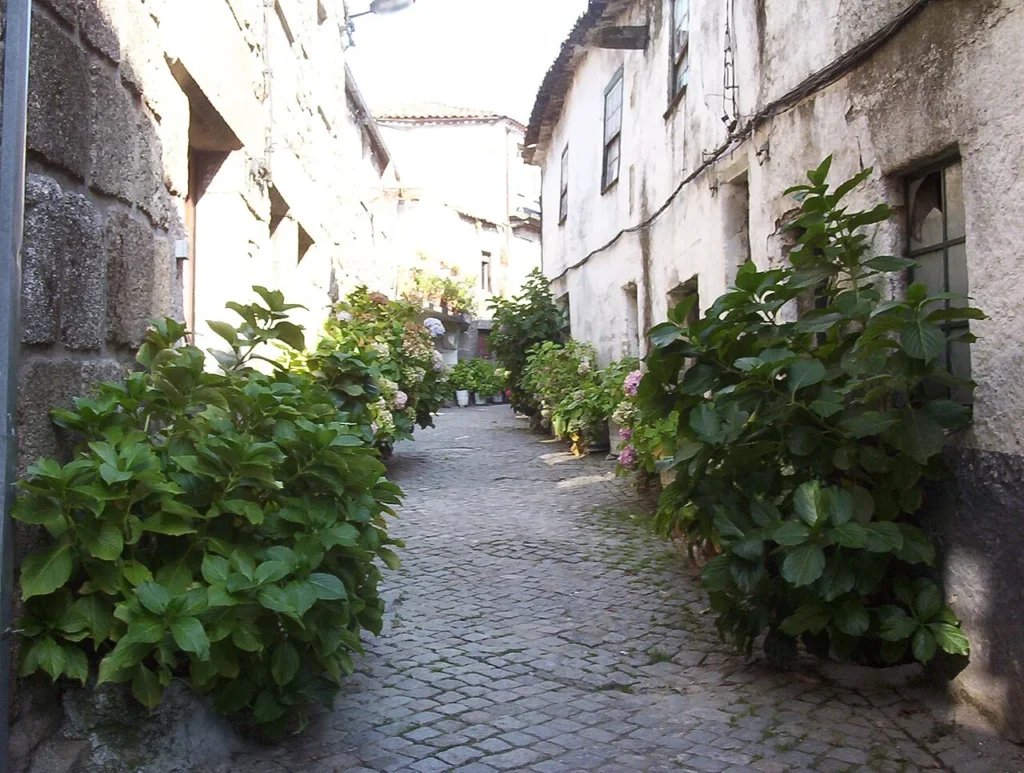
Municipal and historical references connect the former Jewish area with streets and places such as Rua da Alegria, Rua de São João, Rua da Estrela, Rua do Bandarra, Largo Luís de Albuquerque, Poço do Mestre, and Praça D. Dinis. Rua da Alegria is often identified as a possible survival of the old Rua da Judiaria because of the concentration of cruciform marks in that area. This identification is plausible, but it should not be treated as fully proven by a medieval document.
Houses, Marks and Material Traces
Trancoso preserves one of the richest groups of marks associated with Jews and New Christians in Portugal. Studies and local inventories record around 150 cruciform and religious marks in the historic centre and in nearby villages of the municipality. These include crosses, religious inscriptions, Hebrew inscriptions, longitudinal marks, and carved menorot.
The interpretation of these marks requires caution. Some may have been made by Old Christians, while others may relate to New Christian families publicly affirming Christian identity after the forced conversions. In this context, the material record is valuable precisely because it preserves traces of a population living between inherited Jewish memory, imposed Christianity, and inquisitorial pressure.
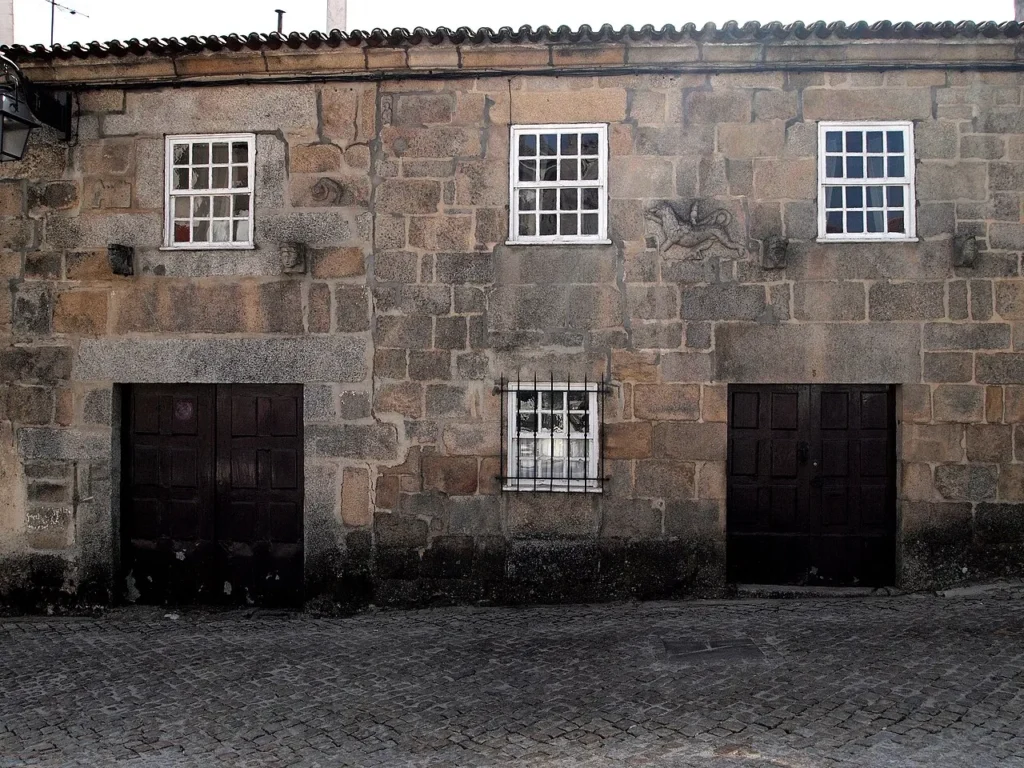
In Rua da Estrela, there are references to a Greek cross with a Hebrew letter associated with the word for God and to a fragment interpreted as part of a menorah. In Rua do Bandarra, there is a carved candelabrum. In Largo Luís de Albuquerque, the Casa do Gato Preto, also known as the Casa do Leão de Judá, preserves carved elements associated with Jewish iconography, including the Lion of Judah and the so-called Gate of Jerusalem. The provenance and precise dating of these carved elements are not fully secure, so they should be presented as part of the local Jewish heritage record, not as definitive proof of the building’s original medieval function.
Another important reference is the house at Praça D. Dinis, no. 5, associated in local heritage literature with Jewish and later New Christian occupation. Its doorposts preserve cruciform marks, and inside the house a leather roll containing a parchment with the Shema Israel prayer was reportedly found.
Named Figures
The strongest later figure connected to Trancoso’s Jewish and New Christian history is Fernando Isaac Cardoso, born in Trancoso in 1603 or 1604 into a New Christian family. In exile, he openly assumed Jewish identity and became a physician, philosopher, and author. His major works include Philosophia Libera, published in Venice in 1673, and Las excelencias y calunias de los Hebreos, published in Amsterdam in 1679. The Jewish Interpretation Centre of Trancoso bears his name.
Documentation also preserves names such as Mestre Manuel, a surgeon who came to Trancoso after marrying Lucrécia Nunes. Gonçalo Anes Bandarra, born in Trancoso around 1500, should not be presented as Jewish. However, his prophetic writings circulated in an environment strongly marked by New Christian experience, messianic expectation, and inquisitorial anxiety.
Gallery
Sources & Bibliography
- CÂMARA MUNICIPAL DE TRANCOSO. Património Judaico. Local: Trancoso. Editora: Câmara Municipal de Trancoso. Ano: n.d
- CÂMARA MUNICIPAL DE TRANCOSO. Casa do Gato Preto. Local: Trancoso. Editora: Câmara Municipal de Trancoso. Ano: n.d
- CÂMARA MUNICIPAL DE TRANCOSO. Centro de Interpretação Judaica Isaac Cardoso. Local: Trancoso. Editora: Câmara Municipal de Trancoso. Ano: n.d
- SANTOS, Carlos Alberto; BALESTEROS, Carmen. Arqueologia Judaica no Concelho de Trancoso: Novos Elementos. Cadernos de Estudos Sefarditas, no. 4. Ano: 2004.
- SISTEMA DE INFORMAÇÃO PARA O PATRIMÓNIO ARQUITETÓNICO. Casa Judaica / Casa do Gato Negro em Trancoso. Local: Trancoso. Editora: SIPA. Ano: n.d
Article researched and curated by Jew Where.
The Jew Where project is collaborative. Do you have additional information, found an inaccuracy, or have historical photos of this location? Contact our team.
Community notes
Comments
Logged-in visitors can submit comments for moderation before they appear publicly.
No comments yet.
Log in to leave a comment. Go to Account.