
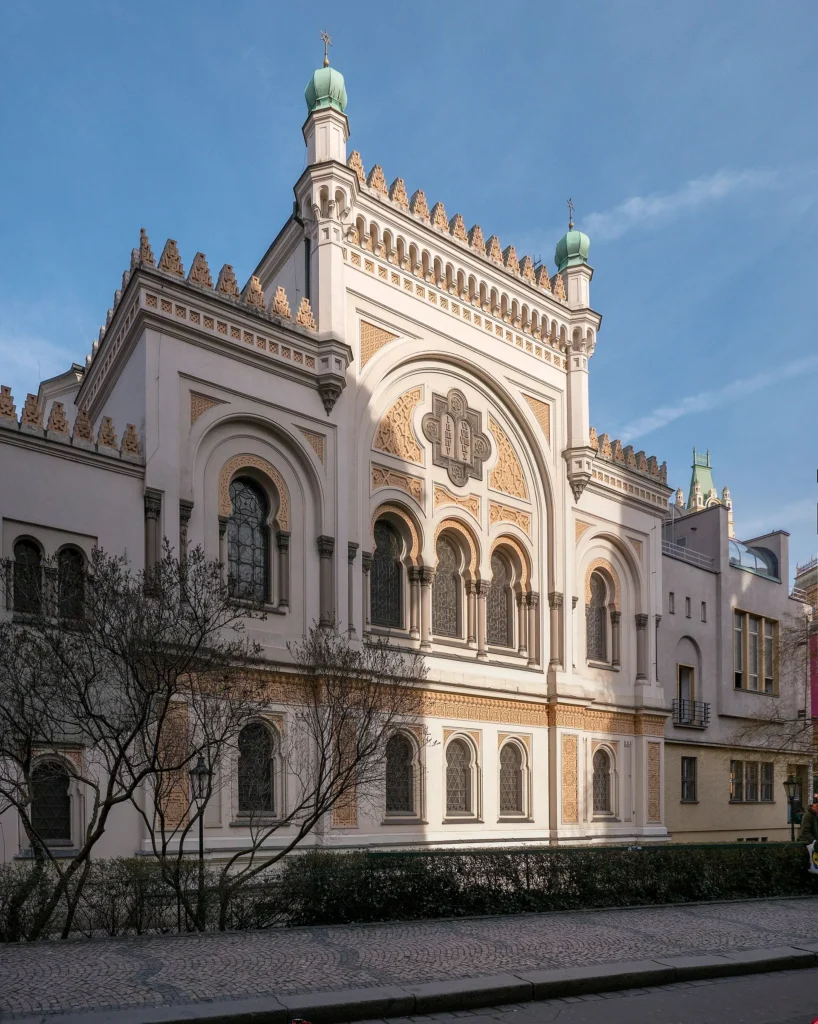
The Spanish Synagogue stands in Josefov, the former Jewish Town of Prague, near Dušní Street and the Church of the Holy Spirit. It is the most recent synagogue built in the historic Jewish Town and today one of the main sites of the Jewish Museum in Prague.
From the Old Shul to the Spanish Synagogue
The site is older than the present building. The Spanish Synagogue was built on the place of the Old Shul, also known as the Altschul, which was regarded as the oldest Jewish house of worship in the Prague ghetto. The Old Shul was demolished in 1867.
In 1835, the first Society for Regulated Worship in accordance with the Viennese rite was founded in Prague’s Old Shul. This marked an important stage in the religious and cultural transformation of Jewish Prague during the nineteenth century.
The new synagogue was commissioned in 1867-1868 by the Society for Regulated Worship among the Israelites in Prague. It was designed by Vojtěch Ignác Ullmann and Josef Niklas, with Jan Bělský responsible for construction.
Its name does not mean that the synagogue belonged to a Sephardic community or followed the Sephardic rite. The name “Spanish Synagogue” refers to its Moorish Revival decoration, inspired by Islamic-period architecture in Spain, especially the Alhambra.
Architecture and Reform Worship
The Spanish Synagogue expresses the nineteenth-century transformation of Jewish Prague. A medieval synagogue site was replaced by a modern urban synagogue connected to Reform worship, galleries, music, an organ and a new architectural language.
The former Old Shul was also associated with František Škroup, composer of the Czech national anthem, who served there as choirmaster between 1835 and 1845.
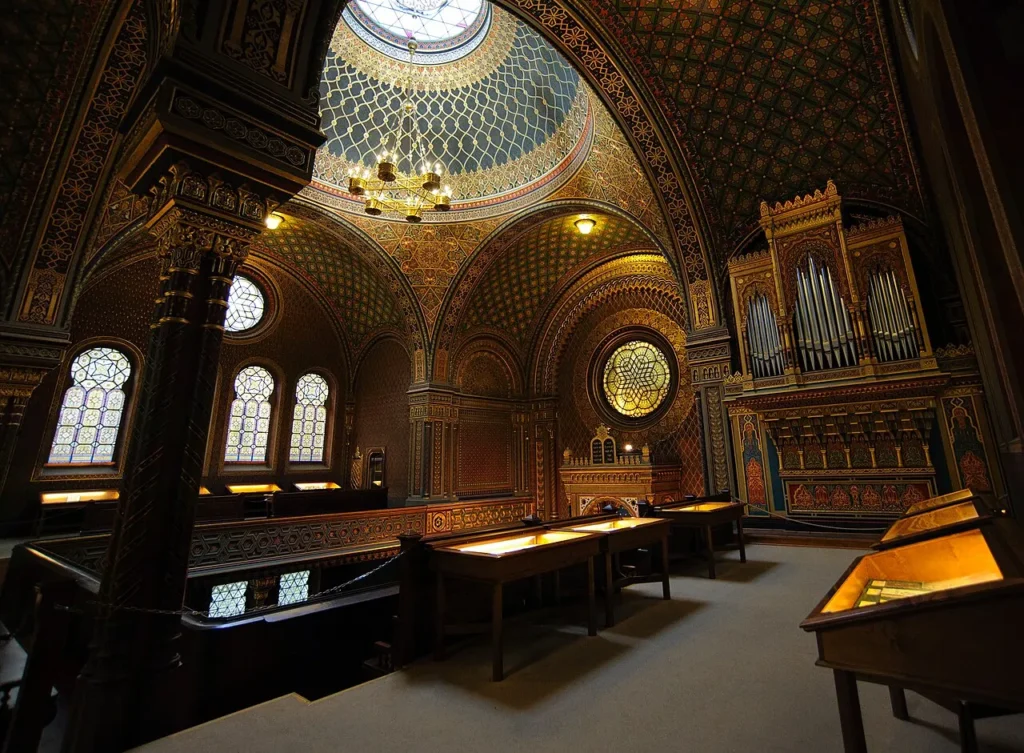
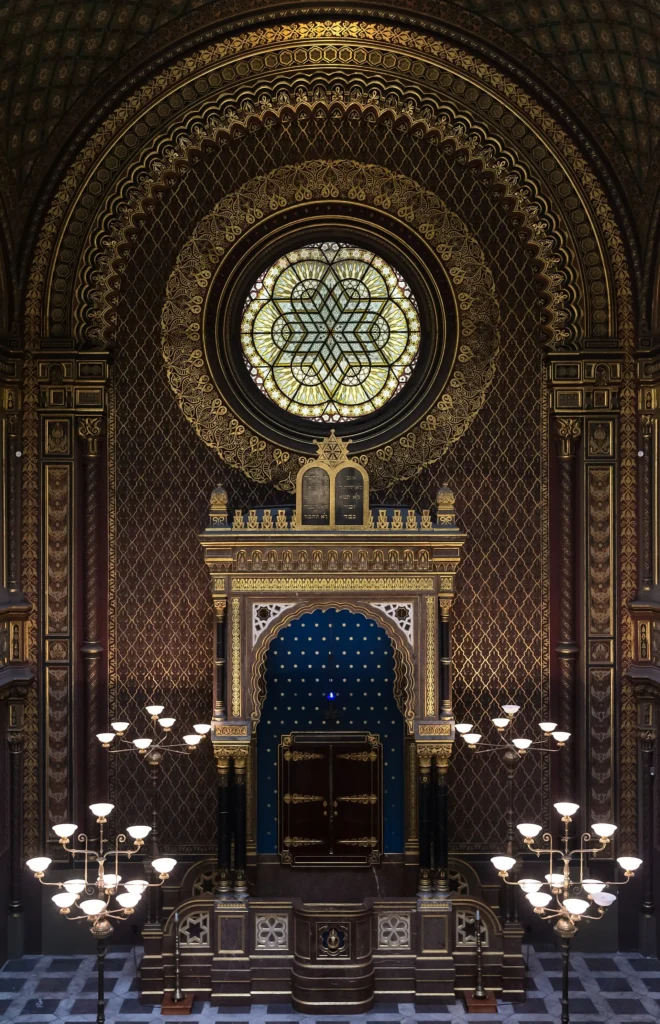
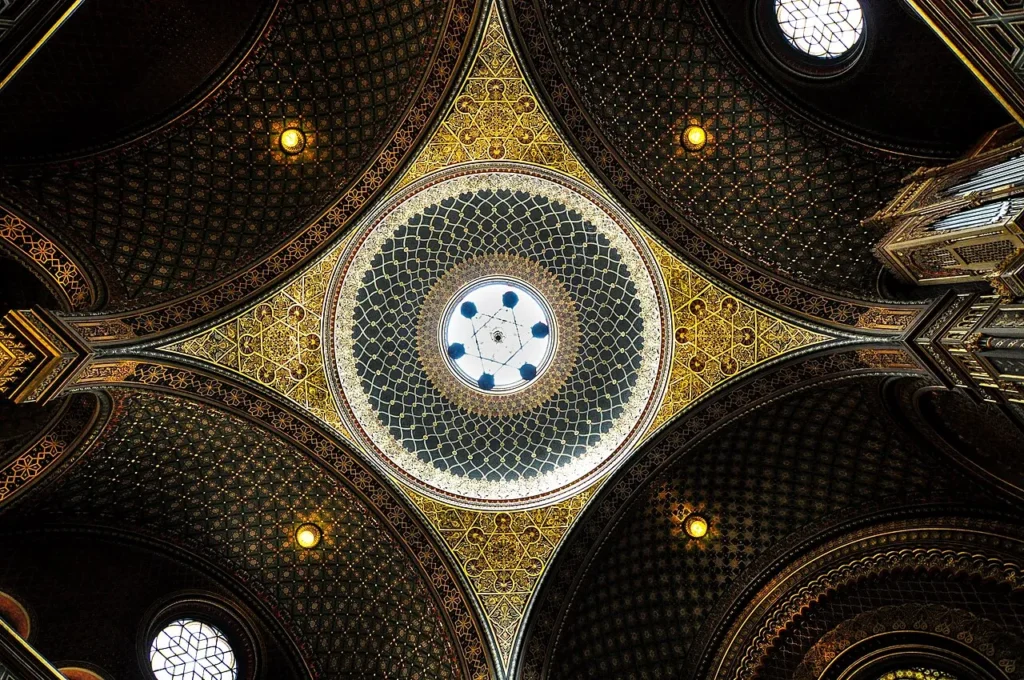
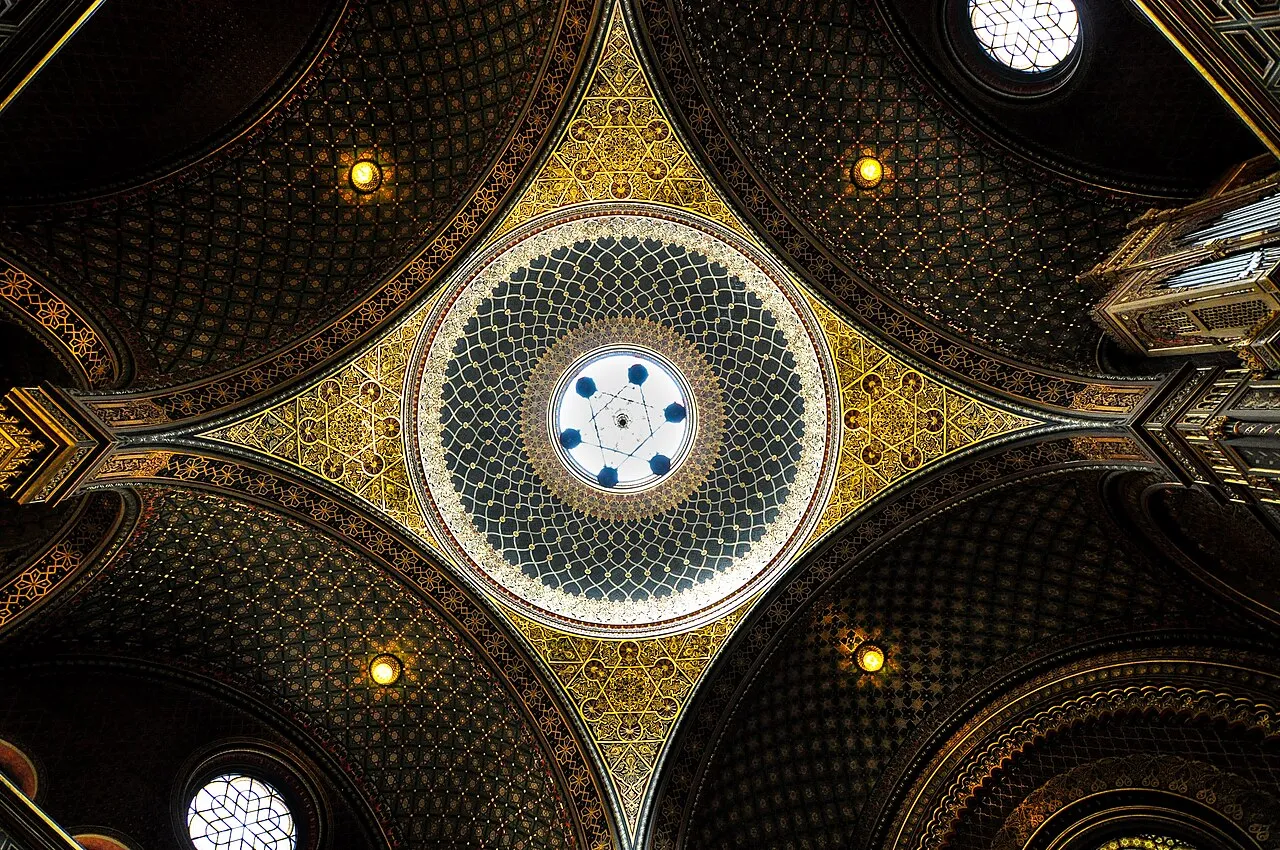
The richly decorated interior was completed between 1882 and 1883 by Antonín Baum and Bedřich Münzberger. The synagogue has a square ground plan, a large central dome, built-in galleries and an Aron ha-Kodesh, the Torah ark, shaped like a mihrab-like niche. Its interior combines polychrome decoration, gilding, stained glass and ornamental stucco arabesques.
In 1935, a Functionalist annex was added beside the Spanish Synagogue, based on a design by Karel Pecánek. The extension included a vestibule and an upper-floor winter prayer room connected to the synagogue. It was also used by the Jewish community as a hospital before the Second World War.
The Spanish Synagogue and the Jewish Museum
During the Second World War, the Spanish Synagogue was used as a warehouse for items confiscated from synagogues in Bohemia and Moravia. Its wartime role belongs to the wider history of the Jewish Museum in Prague and the Central Jewish Museum, where liturgical objects, books and archival documents from Jewish communities were gathered under Nazi control.
In 1955, the Spanish Synagogue came under the care of the State Jewish Museum. Its interior was reconstructed in 1958-1959, and an exhibition of synagogue textiles opened there in 1960. The building later fell into neglect and was closed in 1982. Its full reconstruction took place after the fall of the Communist regime, and the synagogue reopened in 1998.
Today, the Spanish Synagogue houses the permanent exhibition Jews in the Bohemian Lands, 19th-20th Centuries. The exhibition presents Jewish emancipation, the Czech-Jewish movement, Zionism, the Hilsner Affair, the urban renewal of the Jewish Town, the Holocaust and the post-war renewal of Jewish life.
The exhibition also presents figures connected to modern Jewish culture in Central Europe, including Franz Kafka, Sigmund Freud and Gustav Mahler. Among its displayed objects are a Hanukkah menorah from 1785 with a portrait of Emperor Joseph II and material documenting Jewish monuments in Bohemia and Moravia.
Gallery
Sources & Bibliography
- Jewish Museum in Prague. Spanish Synagogue. Editora: Jewish Museum in Prague. Ano: n.d
- Jewish Museum in Prague. Jews in the Bohemian Lands, 19th-20th Centuries. Editora: Jewish Museum in Prague. Ano: n.d
- Jewish Museum in Prague. History of the Museum. Editora: Jewish Museum in Prague. Ano: n.d
- Jewish Museum in Prague. The Spanish Synagogue reopening to the public after reconstruction. Editora: Jewish Museum in Prague. Ano: n.d
- Pavlát, Leo. The Jewish Museum in Prague during the Second World War. European Judaism, vol. 41, no. 1. Editora: Berghahn Journals. Ano: 2008
- Veselská, Magda. Ark of Memory: The Jewish Museum in Prague’s Journey Through the Turbulent Twentieth Century. Editora: Jewish Museum in Prague / Academia. Ano: n.d
- Giustino, Cathleen M. Tearing Down Prague’s Jewish Town: Ghetto Clearance and the Legacy of Middle-Class Ethnic Politics around 1900. Editora: East European Monographs. Ano: 2003
Article researched and curated by Jew Where.
The Jew Where project is collaborative. Do you have additional information, found an inaccuracy, or have historical photos of this location? Contact our team.
Community notes
Comments
Logged-in visitors can submit comments for moderation before they appear publicly.
No comments yet.
Log in to leave a comment. Go to Account.