

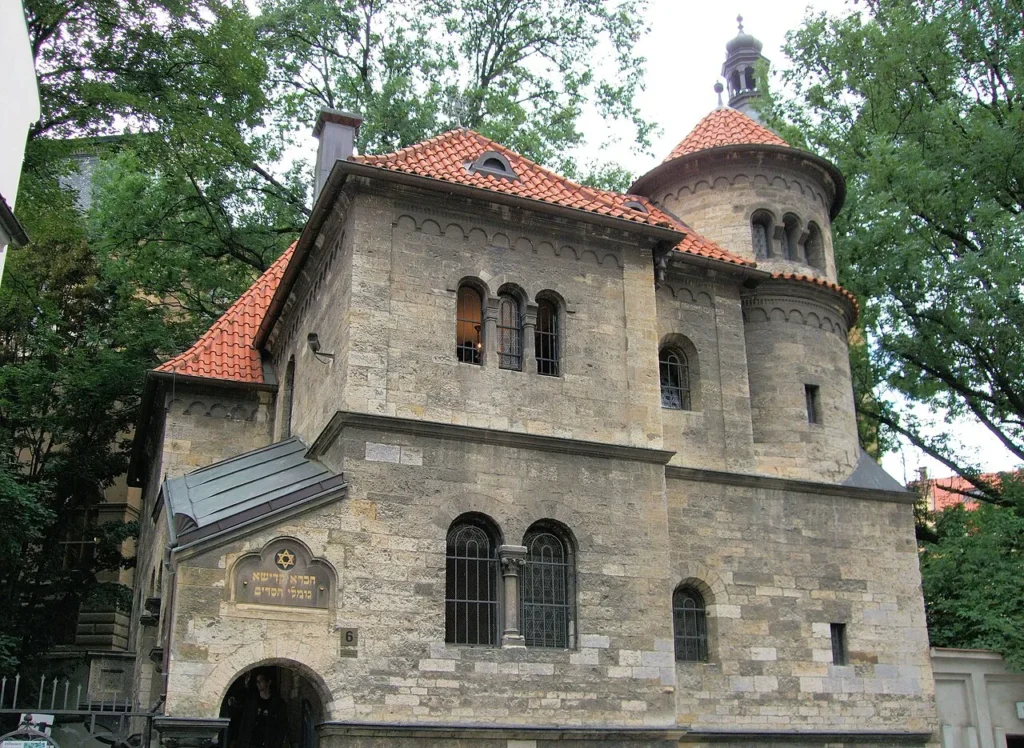
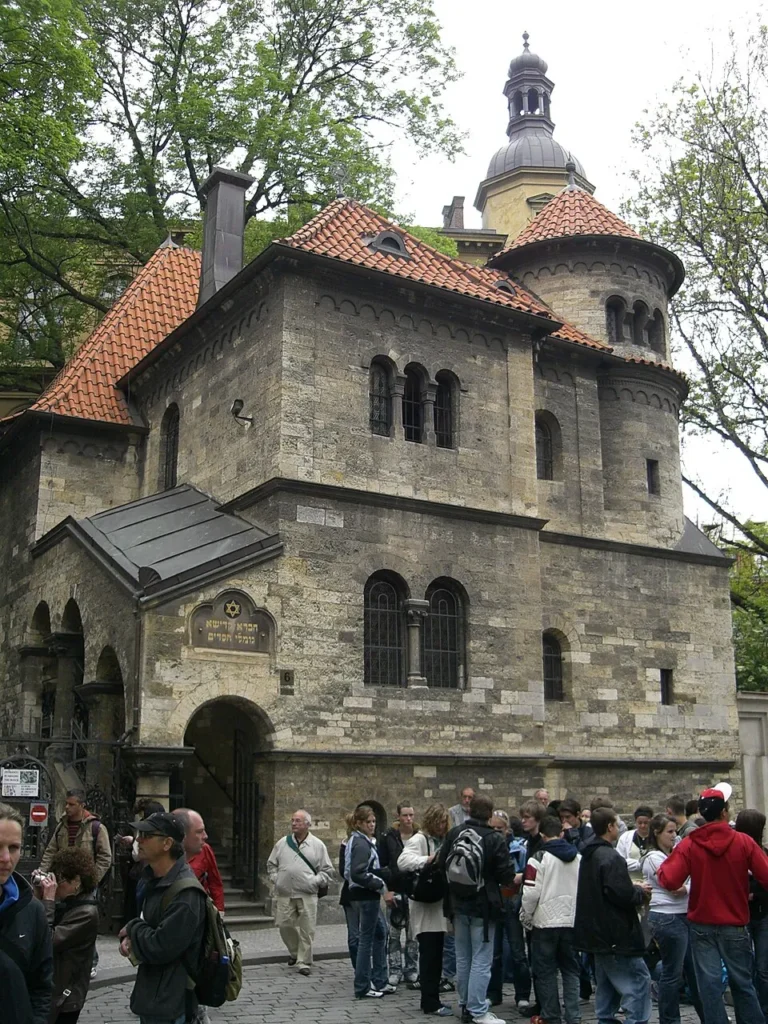
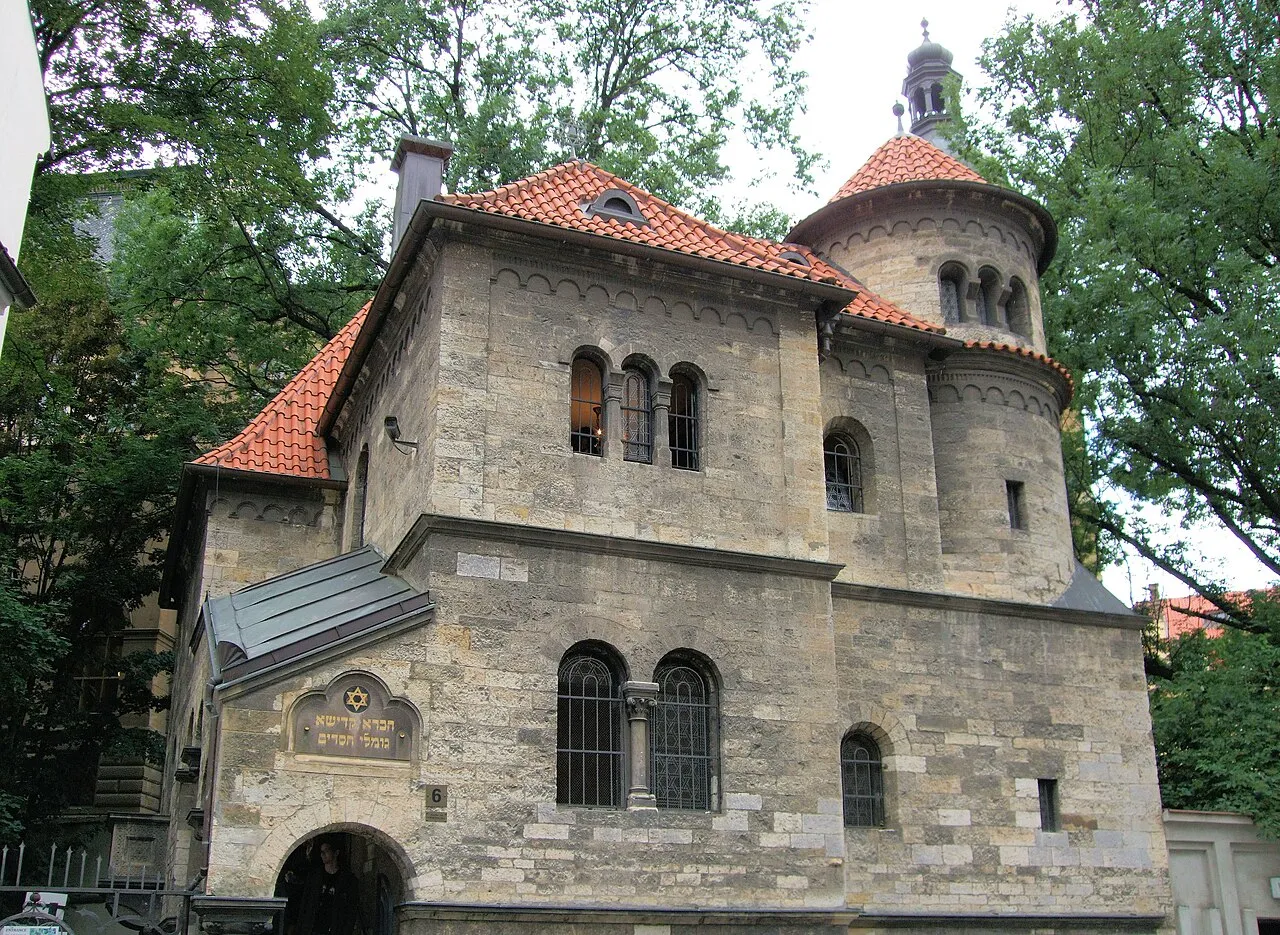
The Ceremonial Hall stands beside the Old Jewish Cemetery and the Klausen Synagogue in Josefov, the former Jewish Town of Prague. It belonged to the Prague Jewish Burial Society, the Hevra Kadisha, one of the most important communal institutions of Jewish Prague.
Prague Hevra Kadisha
The Prague Hevra Kadisha was founded in 1564 by Rabbi Eliezer Ashkenazi. Its statutes were later revised by Rabbi Judah Loew ben Bezalel, the Maharal of Prague, and became influential for burial societies across Ashkenazi Europe.
The society was responsible for visiting the sick, caring for the dying, purifying the body, organizing burial and supporting the rituals of mourning. Within this framework, burial was not only a practical duty. It was a communal act governed by dignity, discipline and religious responsibility.
Ceremonial Hall and Burial Practice
The present Ceremonial Hall was built between 1906 and 1908, on the grounds of the Old Jewish Cemetery. It was designed by Jan Gerstl and Alois Gabriel in a Neo-Romanesque style. Although the building appears medieval at first sight, it belongs to the early twentieth century and reflects the historicist architecture of that period.
The building was created for the final services connected to burial. Its basement contained a mortuary, from which funeral processions departed for the New Jewish Cemetery. The hall was also equipped with one of the first technical elevators in Prague.
The most important ritual associated with the building was taharah, the purification of the body before burial. In Jewish funerary practice, taharah forms part of a broader system of care toward the dead, carried out by the burial society before interment.
The Ceremonial Hall stood at the edge of the Old Jewish Cemetery, where burials had ended in 1787. Its location preserved a physical link between the old burial ground of Prague’s Jewish community and the later funerary system that led to the New Jewish Cemetery.
The building served its original funerary purpose only until the beginning of the 1920s. In 1926, the Prague Burial Society leased the Ceremonial Hall to the Jewish Museum in Prague. The museum opened its first exhibition there, transforming a former funerary building into a museum space while preserving its connection to burial customs and communal memory.
Museum, War and Reconstruction
During the Nazi occupation, the Jewish Museum Association was abolished in 1939. In 1942, the Central Jewish Museum was created under Nazi control. The Nazi authorities approved the project for their own purposes, but Jewish museum workers used the institution to preserve liturgical objects, books and archival records from Jewish communities in Bohemia and Moravia that were being dismantled and destroyed.
Objects connected to the Prague Burial Society entered the museum collections during this period. Among them was a major series of paintings showing the work of the Burial Society, including visiting the hospital, praying by the deathbed, shrouding the body, washing the corpse, making the coffin, digging the grave, carrying the coffin, lowering the coffin into the grave and consoling the bereaved.
After the war, the museum came under state administration and was nationalized in 1950. The Ceremonial Hall continued to function as part of the State Jewish Museum’s exhibition system under the Communist regime.
In 1994, after the fall of Communism, the Jewish Museum in Prague regained independence from the state. Its buildings were returned to the Prague Jewish community, and most of its collections were returned to the Federation of Jewish Communities in the Czech Republic.
From 1997 to 2024, the Ceremonial Hall housed an exhibition dedicated to Jewish burial customs. The exhibition focused on illness, death, taharah, burial, memorial prayers, Jewish cemeteries and the internal life of burial societies.
The display included material connected to the Prague Burial Society, illuminated manuscripts, silver alms boxes, fragments of medieval tombstones, memorial prayers and images of the Old Jewish Cemetery of Prague.
In July 2024, the Ceremonial Hall entered a new phase of reconstruction. The Jewish Museum in Prague announced a restoration project planned through the second half of 2026, with new exhibitions dedicated to Jewish funerary culture, the Burial Society and the urban transformation of Josefov.
Gallery
Sources & Bibliography
- JEWISH MUSEUM IN PRAGUE. Ceremonial Hall. Prague: Jewish Museum in Prague. Year: n.d
- JEWISH MUSEUM IN PRAGUE. History of the Museum. Prague: Jewish Museum in Prague. Year: n.d
- JEWISH MUSEUM IN PRAGUE. How you can support us: Renovation of the Ceremonial Hall of the Prague Burial Society. Prague: Jewish Museum in Prague. Year: n.d
- JEWISH MUSEUM IN PRAGUE. Paintings: A Set of Paintings of the Prague Burial Society. Prague: Jewish Museum in Prague. Year: n.d
- PAVLÁT, Leo. The Jewish Museum in Prague during the Second World War. European Judaism, vol. 41, no. 1. Year: 2008
- VESELSKÁ, Magda. Ark of Memory: The Jewish Museum in Prague’s Journey Through the Turbulent Twentieth Century. Prague: Academia and Jewish Museum in Prague. Year: 2012
- PAŘÍK, Arno, and HAMÁČKOVÁ, Vlastimila. Pražské židovské hřbitovy / Prague Jewish Cemeteries / Prager jüdische Friedhöfe. Prague: Jewish Museum in Prague. Year: 2008.
- GIUSTINO, Cathleen M. Tearing Down Prague’s Jewish Town: Ghetto Clearance and the Legacy of Middle-Class Ethnic Politics around 1900. Boulder: East European Monographs. Year: 2003.
Article researched and curated by Jew Where.
The Jew Where project is collaborative. Do you have additional information, found an inaccuracy, or have historical photos of this location? Contact our team.
Community notes
Comments
Logged-in visitors can submit comments for moderation before they appear publicly.
No comments yet.
Log in to leave a comment. Go to Account.