

The Jewish presence in Vila Nova de Portimão is attested for the late fifteenth century and is known mainly through royal and notarial documentation, complemented for the sixteenth and seventeenth centuries by records and dynamics associated with the Holy Office. The judiaria already existed in 1489, with the leasing of houses in the Jewish quarter to the Jew Lezer Gaguim, and in 1490 there is a letter of pardon granted to Isaac Bodarros and Baruh Bodarros, both identified as Jews from Portimão, as well as references to Samuel Alferce, a Jew residing in Portimão, connected to contracts and confirmations of leases in the Algarve during the 1490s. The same documentary tradition indicates that the judiaria was located within the town walls and was served by its own gate, integrated into an intramural urban fabric whose reading today depends on the layout of the historic center and on sporadic evidence of structures revealed by construction works and demolitions.
The historical topography of the intramural nucleus becomes clearer when documentation mentions boundaries descending from the gate of the judiaria to the Porta das Freiras, including reference to a monturo dos judeus, a refuse dump associated with the quarter, and when the possibility is discussed that certain postigos and alignments relate to former gates between the Porta de São João and the area of the parish church. These data do not preserve an identifiable medieval synagogue building, but they do establish the existence of a quarter, a gate, and an urban management framework that distinguished the Jewish area within the fifteenth-century town.
The institutional rupture occurred with the edict of 1496 and the forced conversions, after which Jewish presence is read primarily through the world of the New Christians. In the sixteenth century, Portimão emerges as a decisive point in the regional inquisitorial chronology. In December 1558, a New Christian woman from Vila Nova de Portimão, Grácia Mendes, appeared before the vicar-general of the Algarve to confess Judaizing practices and denounce others, an episode associated with the beginning of the first entry of the Inquisition into the Algarve. Repression intensified in the following decades, and the scale of local impact is underscored by a recent synthesis: between 1584 and 1604, Portimão accounted for about 60 percent of those condemned in the Algarve for Judaism, a total of 99 people, a strong indicator of the town’s relative weight in persecution and in the New Christian networks of the region.
Among the figures associated with the historical projection of Portimão in the Sephardic diaspora, João Pinto Delgado (1580–1653) stands out. Born in Vila Nova de Portimão, he became a figure of crypto-Jewish poetry and later a member of the Sephardic milieu in Amsterdam, where he is identified as Moshe Pinto Delgado and took part in communal institutions. His trajectory provides a concrete example of how New Christian families from the Algarve connected with Atlantic and northern European centers, in a movement in which mobility, commerce, inquisitorial surveillance, and the reconstitution of identity went hand in hand.
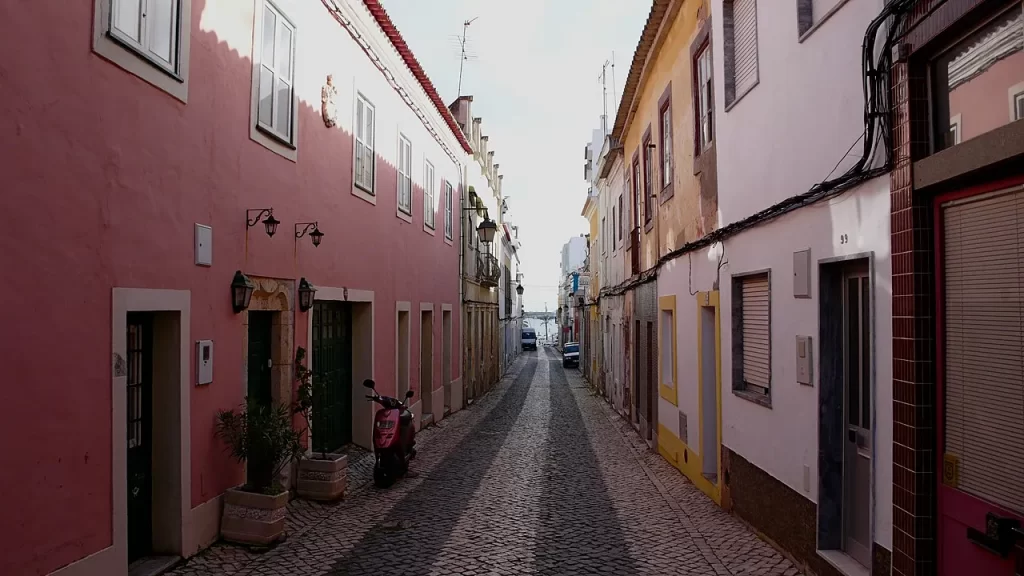
From the perspective of contemporary memory, there is journalistic reference to a street in the old part of Portimão where a judiaria is thought to have existed, an evocation that survives as urban memory even without stable toponymic confirmation in current use. What remains, therefore, is a combination of ancient urban structure, vestiges of walls and gates discussed by local historiography, and documentation that fixes people, statuses, and places, with the Inquisition marking the moment of greatest social destruction through arrests, condemnations, and forced displacements.
In the nineteenth century, organized Jewish return in the Algarve is clearly documented mainly in Faro, with a community formed by Jews coming from Gibraltar and North Africa, leaving a strong material testimony in the Jewish Cemetery of Faro, among other traces. For Portimão, in the syntheses consulted on the town between the fifteenth and seventeenth centuries and on the regional nineteenth-century return, there does not appear to have been a structured communal reestablishment with the same institutional visibility recognized in Faro, although this does not exclude individual presences and circulation within the Algarve economy of the period.
Gallery
Sources & Bibliography
- INÁCIO, Nuno Campos. História do Condado de Vila Nova de Portimão (1465-1698). 1ª ed. Local: Albufeira. Editora: Arandis Editora. Ano: 2017
- SOYER, François. King João II of Portugal “O Principe Perfeito” and the Jews (1481-1495). Local: Madrid. Editora: Sefarad. Ano: 2009
- VIEIRA, Carla da Costa. Uma amarra ao mar e outra à terra. Cristãos-novos no Algarve (1558-1650). Tese de Doutoramento. Local: Lisboa. Editora: Faculdade de Ciências Sociais e Humanas, Universidade Nova de Lisboa. Ano: 2013
- TORRES, Joana Bento; TEIXEIRA, André. A vida quotidiana em Portimão nos séculos XV-XVIII. In: Histórias que o rio nos traz. Local: Portimão. Editora: Câmara Municipal de Portimão, Museu de Portimão/DMP. Ano: 2024
- FRADE, Florbela Veiga. Identidade conversa e a Historia de Rut (1627) de João (Moshe) Pinto Delgado. Local: Lisboa. Editora: Universidade Católica Portuguesa. Ano: 2013
- THE POSEN LIBRARY OF JEWISH CULTURE AND CIVILIZATION. João Pinto Delgado. Ano: n.d
- SIPA. Cemitério da Colónia Judaica de Faro. Ano: n.d
Article researched and curated by Jew Where.
The Jew Where project is collaborative. Do you have additional information, found an inaccuracy, or have historical photos of this location? Contact our team.
Community notes
Comments
Logged-in visitors can submit comments for moderation before they appear publicly.
No comments yet.
Log in to leave a comment. Go to Account.