

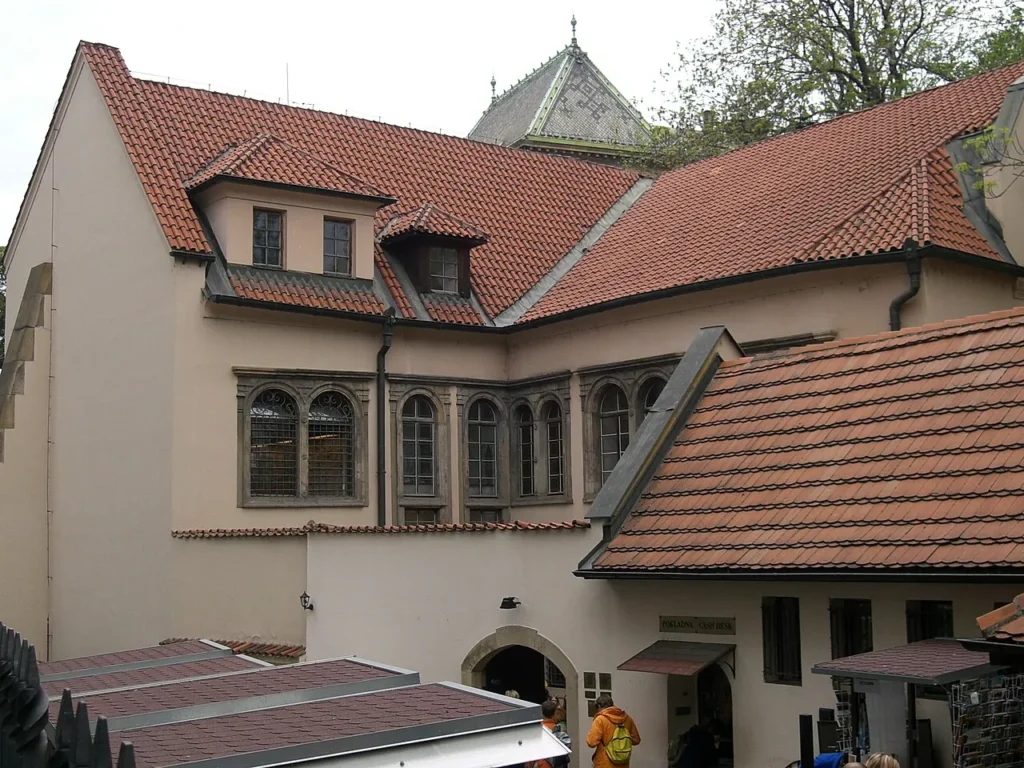
The Pinkas Synagogue stands on Široká Street, beside the Old Jewish Cemetery in Josefov, the former Jewish Town of Prague. After the Old-New Synagogue, the Pinkas Synagogue is one of the oldest surviving synagogues of Prague’s Jewish Town.
Early history of the Pinkas Synagogue
A small house of worship already existed on this site before 1492, in the building known as the Coats of Arms House. In 1535, the site was rebuilt and expanded by Aaron Meshulam Horowitz, one of the leading figures of the Prague Jewish community.
A commemorative inscription in the vestibule records the construction of the synagogue in the Jewish year 5295, corresponding to 1535. The building originally functioned as a private house of worship connected to the Horowitz family. Its name is usually linked to Israel Pinkas, an earlier owner of the property.
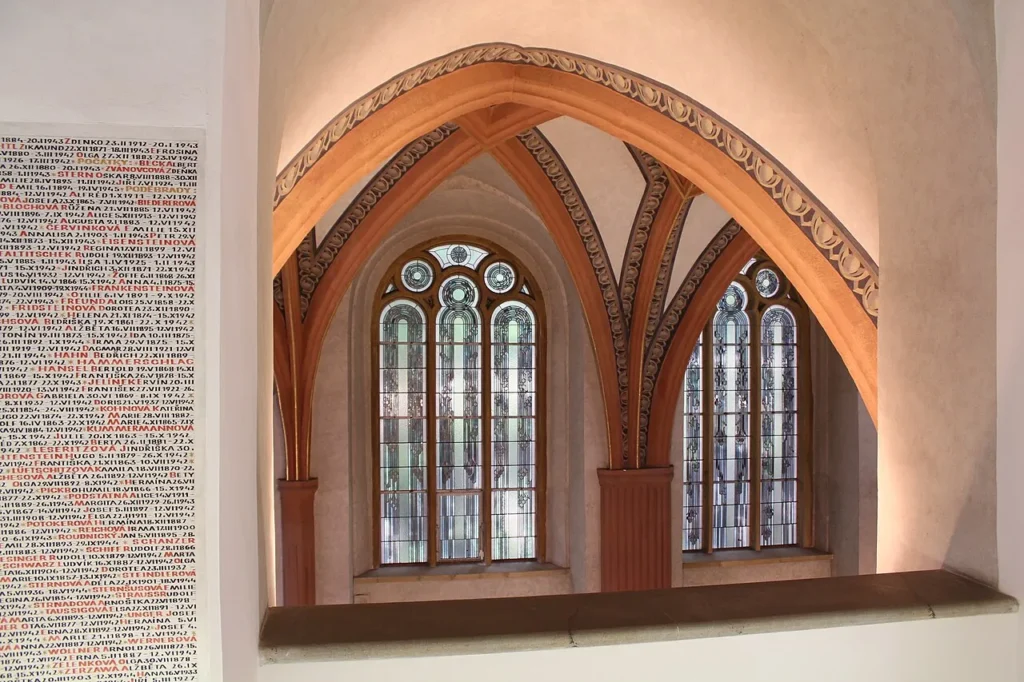
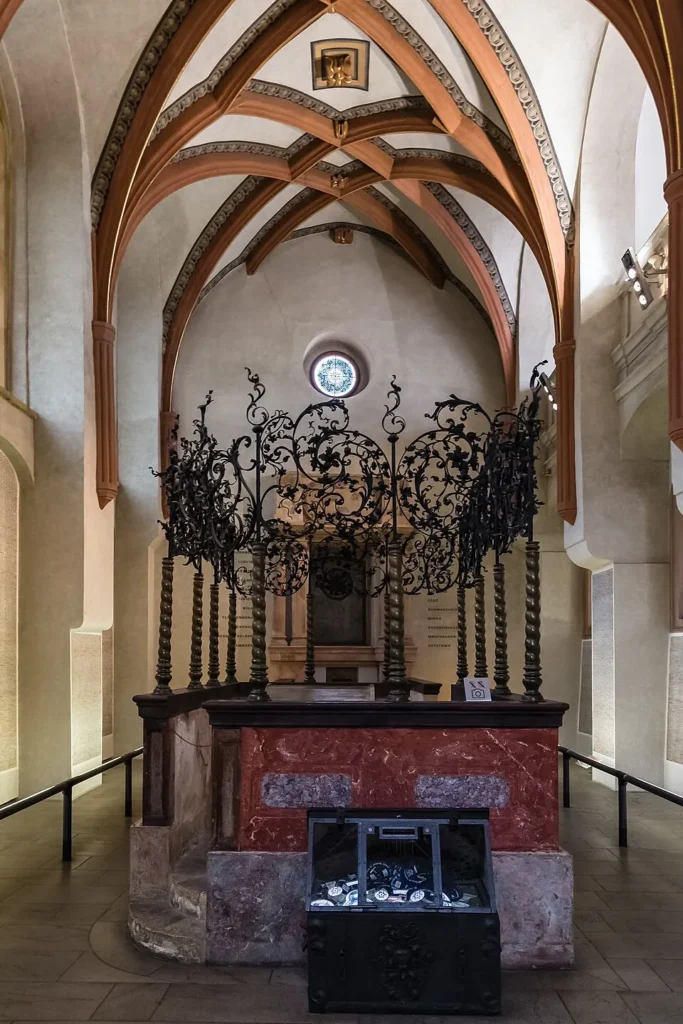
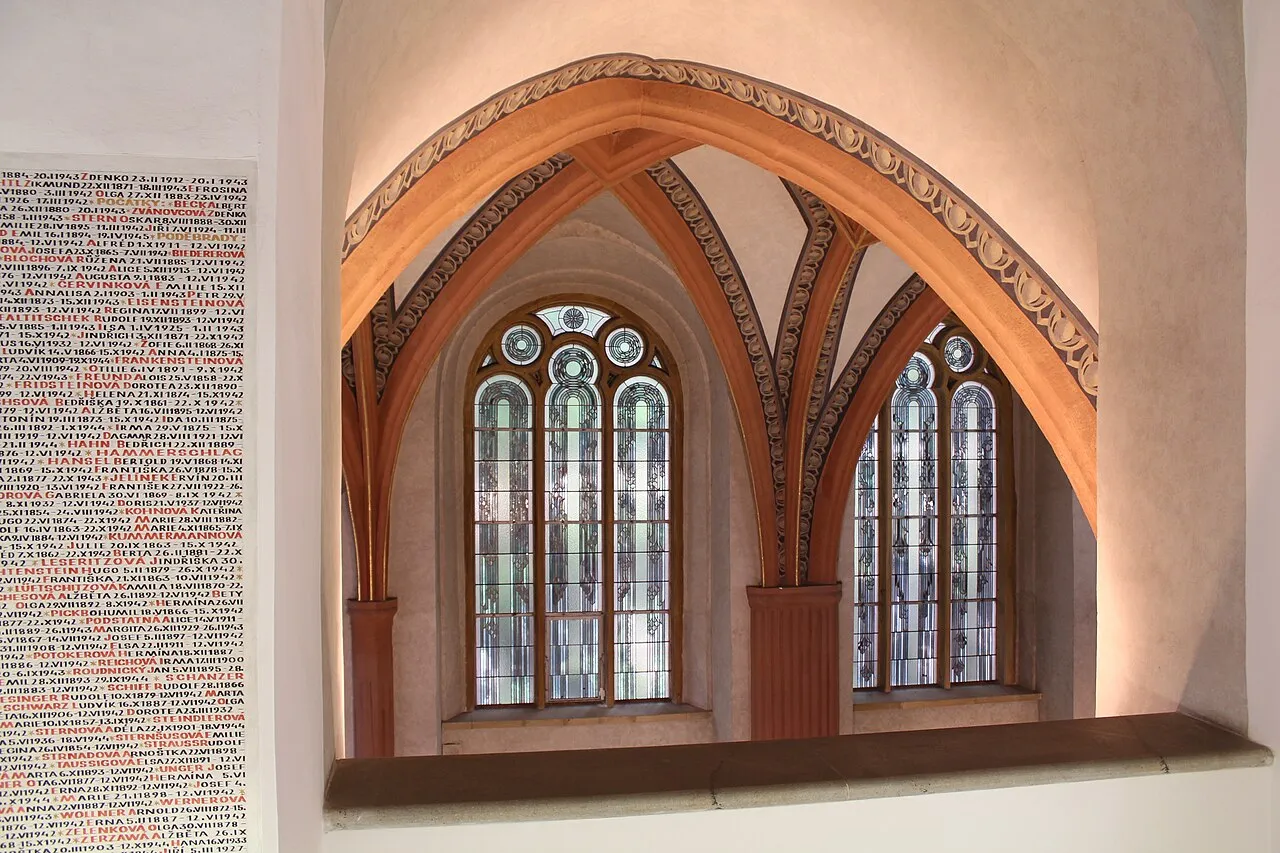
Architecturally, the synagogue combines late Gothic and early Renaissance features. The main nave preserves a late Gothic reticulated vault, while the entrance portal belongs to the early Renaissance. In the early seventeenth century, Judah de Herz added the women’s gallery, vestibule and entrance hall.
The synagogue was repeatedly affected by floods. After flood damage in 1860, the floor of the main hall was raised by about 1.5 metres. This intervention covered earlier levels and changed the proportions of the interior.
During the urban redevelopment of Josefov at the turn of the twentieth century, many old buildings around the synagogue were demolished. The Pinkas Synagogue survived, but the surrounding ground level was raised, leaving the building lower than the modern street level.
Nazi occupation and postwar transformation
During the Nazi occupation and the Second World War, the synagogue was no longer functioning as a normal communal house of prayer. A photograph from 1943 shows the emptied interior being used as a warehouse or repository. This was before the creation of the Shoah memorial.
After the war, the Pinkas Synagogue came under the care of the Jewish Museum in Prague. In the 1950s, a historical and architectural survey was carried out. Restoration work removed nineteenth-century backfill from the main nave, restored the original height and layout of the hall, and uncovered the original bimah.
The idea then emerged to transform the synagogue into a symbolic gravestone for the Jewish victims of the Shoah from the Czech lands. Under the direction of Hana Volavková, the first postwar director of the Jewish Museum in Prague, the memorial was designed by the Czech artists Václav Boštík and Jiří John.
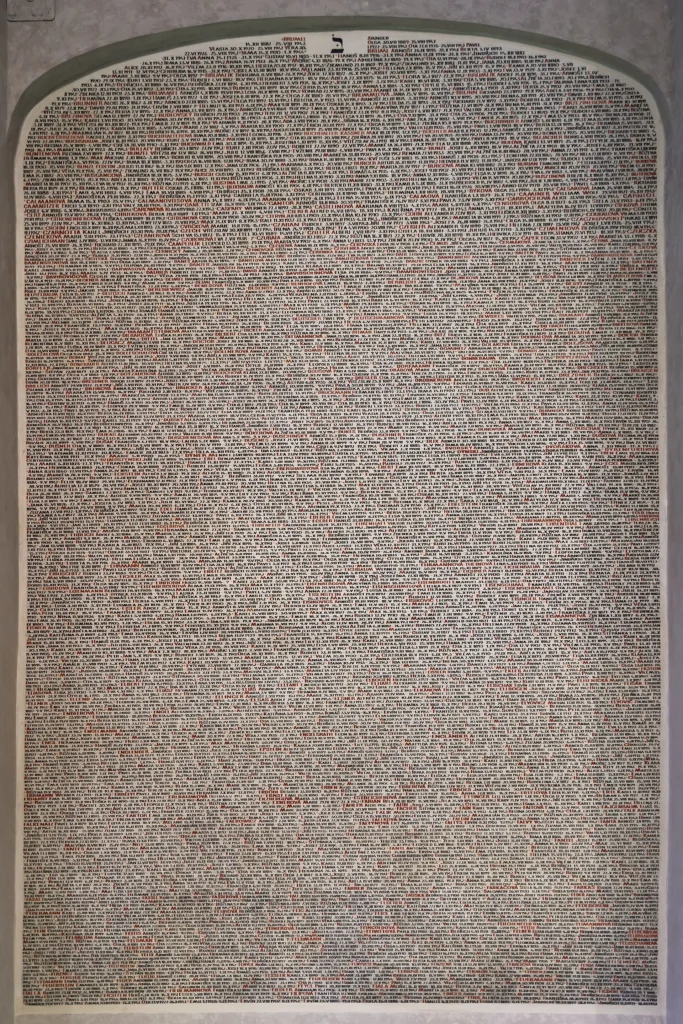
The work was completed in 1959 and opened to the public in 1960. The interior walls were inscribed with the names of almost 80,000 Jewish victims from Bohemia and Moravia. The names were arranged according to the victims’ last place of residence before arrest or deportation, and then listed alphabetically.
The inscriptions were compiled from transport papers, registration lists, survivor accounts and postwar card indexes. Where the exact date of death was unknown, the memorial used the date of deportation to ghettos or extermination camps, often the last known trace of the person.
On both sides of the Aron ha-Kodesh, the Holy Ark, the memorial lists the names of ghettos and death camps to which Jews from Bohemia and Moravia were deported.
Closure, restoration and documentation
In 1968, during restoration work, a historical mikveh was discovered in the basement of the building next to the synagogue. The ritual bath is usually dated to the late fifteenth or early sixteenth century and is one of the important physical traces of Jewish settlement in this part of Prague.
After the Soviet occupation of Czechoslovakia in 1968, the Communist authorities did not restore the memorial to its original state. The Pinkas Memorial remained closed for more than twenty years, and acts of remembrance were rarely possible there.
After the fall of the Communist regime in 1989, restoration of the memorial became possible. The inscriptions were restored according to the original design of Boštík and John, and the work was completed in 1995. The memorial reopened to the public in 1996.
The synagogue was damaged again during the floods of 2002, when water reached the walls and affected the inscriptions. The building was restored and reopened in 2003.
Today, the Pinkas Synagogue functions as the Memorial to the Victims of the Shoah from the Czech Lands. It also houses the exhibition Children’s Drawings from the Terezín Ghetto, 1942-1944, based on the Jewish Museum in Prague’s collection of drawings made by children imprisoned in Terezín.
The Jewish Museum’s Shoah Documentation Department continues to verify, correct and expand the information connected to the memorial, through databases, archival records and family documentation.
Gallery
Videos
Sources & Bibliography
- JEWISH MUSEUM IN PRAGUE. Pinkas Synagogue. Local: Prague. Editora: Jewish Museum in Prague. Ano: n.d
- PINKAS SYNAGOGUE MEMORIAL. History of the Pinkas Synagogue. Local: Prague. Editora: Jewish Museum in Prague. Ano: n.d
- JEWISH MUSEUM IN PRAGUE. Memorial to the Victims of the Shoah from the Czech Lands. Local: Prague. Editora: Jewish Museum in Prague. Ano: n.d
- PINKAS SYNAGOGUE MEMORIAL. Memorial for the Victims of the Shoah from the Czech Lands. Local: Prague. Editora: Jewish Museum in Prague. Ano: n.d
- JEWISH MUSEUM IN PRAGUE. Shoah Documentation. Local: Prague. Editora: Jewish Museum in Prague. Ano: n.d
- JEWISH MUSEUM IN PRAGUE. Children’s Drawings from the Terezín Ghetto, 1942-1944. Local: Prague. Editora: Jewish Museum in Prague. Ano: n.d
- CENTER FOR JEWISH ART, HEBREW UNIVERSITY OF JERUSALEM. Holocaust Memorial in Pinkas Synagogue in Prague. Local: Jerusalem. Editora: Hebrew University of Jerusalem. Ano: n.d
- PAVLÁT, Leo. The Jewish Museum in Prague during the Second World War. European Judaism, vol. 41, no. 1. Ano: 2008
Article researched and curated by Jew Where.
The Jew Where project is collaborative. Do you have additional information, found an inaccuracy, or have historical photos of this location? Contact our team.
Community notes
Comments
Logged-in visitors can submit comments for moderation before they appear publicly.
No comments yet.
Log in to leave a comment. Go to Account.