Skip to content
Memorial to the Victims of the 1506 Jewish Massacre

Memorial to the Victims of the 1506 Jewish Massacre

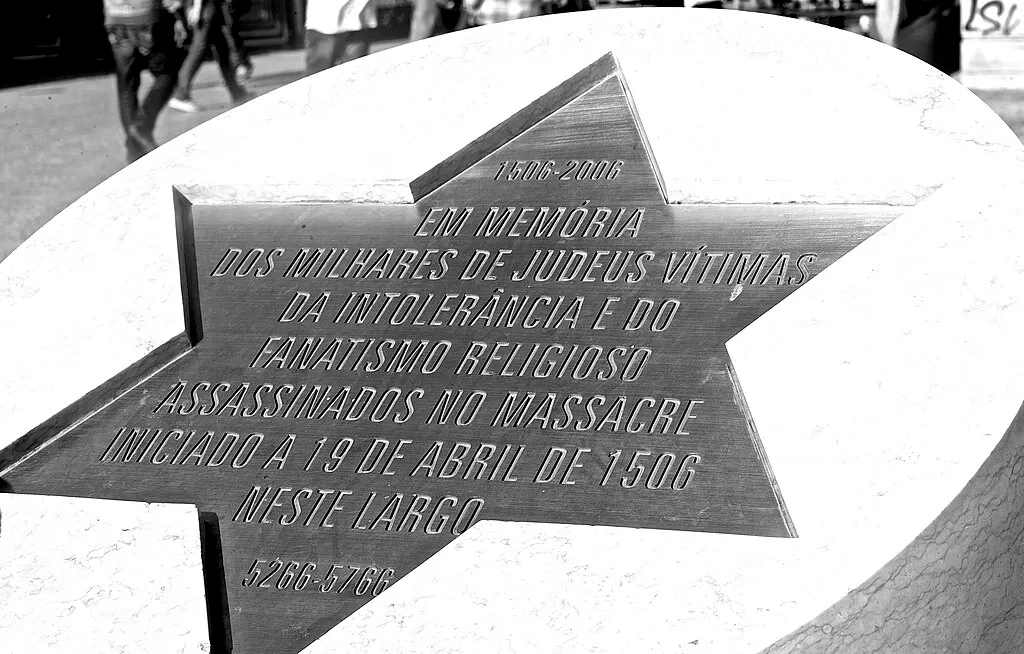
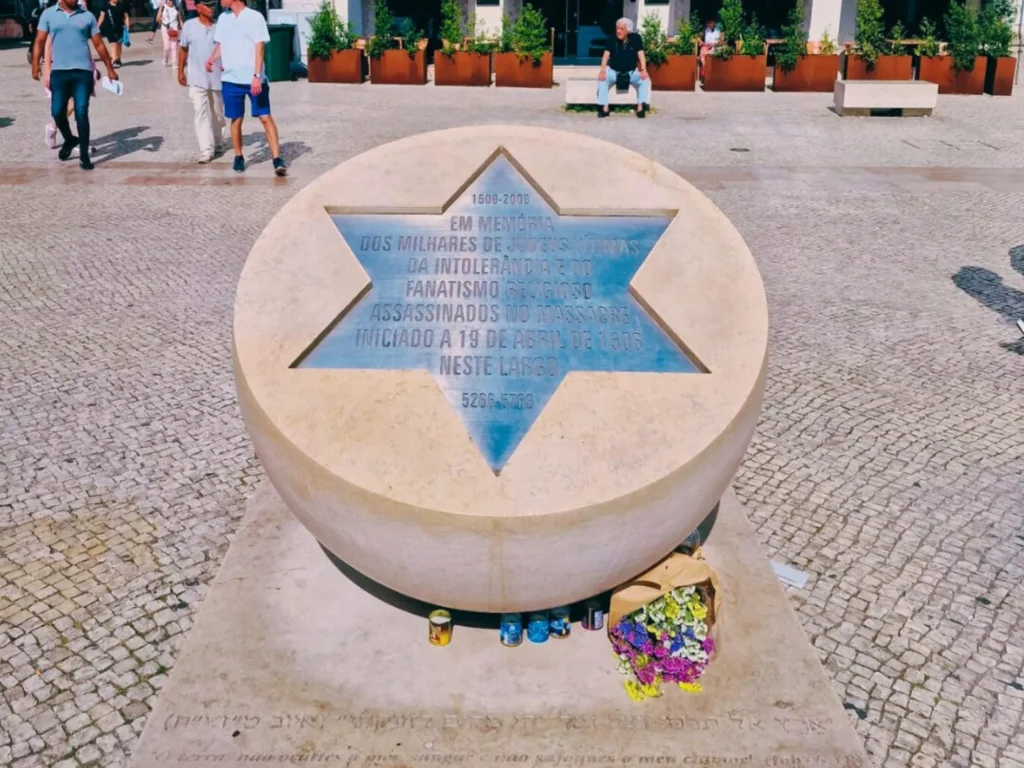
"Stone memorial in Largo de São Domingos, created by Graça Bachmann in 2008, commemorating the 1506 anti-Jewish massacre with Portuguese and Hebrew inscriptions."

Back to Map

Installed in 2008 in the square facing the Church of São Domingos, this memorial marks the site associated with the outbreak of the Lisbon massacre of April 1506 and stands today as one of the city’s most direct public statements on anti-Jewish violence and the fragility of civic order.

The memorial was created by Graça Bachmann, following suggestions and a proposal connected to the Jewish community, and was inaugurated in a public ceremony that brought together municipal authorities and representatives of different faiths.

Formally, the work is a truncated stone sphere, described in official cultural listings as a “world” cut open, a deliberate image of rupture, violence, and chaos. In the plane of that cut, a Magen David is carved out and filled with an inscription that anchors the memorial in place, time, and meaning.

Inside the Star of David, the Portuguese text remembers “the thousands of Jews” who were victims of intolerance and religious fanaticism, murdered in the massacre that began on 19 April 1506 “in this square”. The dates appear both in the Gregorian calendar (1506–2006) and in the Hebrew years (5266–5766), explicitly linking Lisbon’s local trauma to a Jewish chronology of memory.

At the base, on the rectangular stone plinth supporting the sculpture, a Hebrew inscription quotes the Book of Job, traditionally identified as Job 16:18, a short sentence that refuses erasure: “O earth, do not hide my blood, do not hide my cry.” This detail is crucial because it turns the monument into more than a marker, it makes it a moral demand, inscribed at street level, in a place of daily passage.

The event remembered here began in late April 1506 amid crisis, fear, and religious agitation. Contemporary and later accounts describe how violence spread through the city and targeted the so-called “New Christians”, Jews forcibly converted in Portugal, and those suspected of judaizing. Modern scholarship commonly places the death toll somewhere between roughly 1,000 and 4,000 people.

The memorial also sits within a broader institutional landscape of public memory in this square. Next to it, another monument and related initiatives were presented as gestures of remembrance and reconciliation, showing how Largo de São Domingos has become a concentrated urban site where Lisbon narrates a difficult chapter of its own history.

Gallery
Article researched and curated by Jew Where.

The Jew Where project is collaborative. Do you have additional information, found an inaccuracy, or have historical photos of this location? Contact our team.

Memorial to the Victims of the 1506 Jewish Massacre
Portugal / Lisbon / Memory & Holocaust

Memorial to the Victims of the 1506 Jewish Massacre

"Stone memorial in Largo de São Domingos, created by Graça Bachmann in 2008, commemorating the 1506 anti-Jewish massacre with Portuguese and Hebrew inscriptions."

Location
Largo de São Domingos, 1150-320 Lisboa, Portugal

Installed in 2008 in the square facing the Church of São Domingos, this memorial marks the site associated with the outbreak of the Lisbon massacre of April 1506 and stands today as one of the city’s most direct public statements on anti-Jewish violence and the fragility of civic order.

The memorial was created by Graça Bachmann, following suggestions and a proposal connected to the Jewish community, and was inaugurated in a public ceremony that brought together municipal authorities and representatives of different faiths.

Formally, the work is a truncated stone sphere, described in official cultural listings as a “world” cut open, a deliberate image of rupture, violence, and chaos. In the plane of that cut, a Magen David is carved out and filled with an inscription that anchors the memorial in place, time, and meaning.

Inside the Star of David, the Portuguese text remembers “the thousands of Jews” who were victims of intolerance and religious fanaticism, murdered in the massacre that began on 19 April 1506 “in this square”. The dates appear both in the Gregorian calendar (1506–2006) and in the Hebrew years (5266–5766), explicitly linking Lisbon’s local trauma to a Jewish chronology of memory.

At the base, on the rectangular stone plinth supporting the sculpture, a Hebrew inscription quotes the Book of Job, traditionally identified as Job 16:18, a short sentence that refuses erasure: “O earth, do not hide my blood, do not hide my cry.” This detail is crucial because it turns the monument into more than a marker, it makes it a moral demand, inscribed at street level, in a place of daily passage.

The event remembered here began in late April 1506 amid crisis, fear, and religious agitation. Contemporary and later accounts describe how violence spread through the city and targeted the so-called “New Christians”, Jews forcibly converted in Portugal, and those suspected of judaizing. Modern scholarship commonly places the death toll somewhere between roughly 1,000 and 4,000 people.

The memorial also sits within a broader institutional landscape of public memory in this square. Next to it, another monument and related initiatives were presented as gestures of remembrance and reconciliation, showing how Largo de São Domingos has become a concentrated urban site where Lisbon narrates a difficult chapter of its own history.

Timeline

  • 1497 Forced conversion of Portugal’s Jews under King Manuel I, creating the category later called New Christians.
  • 19 April 1506 The massacre begins in the São Domingos area and spreads through Lisbon.
  • 2000 In the same square, Cardinal Patriarch José Policarpo publicly expressed shame for the Church’s role in persecuting Jews and New Christians.
  • 2006 The memorial inscription marks the massacre’s 500th anniversary with the dates 1506–2006 and 5266–5766.
  • April 2008 Graça Bachmann’s memorial was installed in Largo de São Domingos following a proposal connected to the Jewish community.

Sources & Bibliography

  1. Câmara Municipal de Lisboa. Memorial às Vítimas do Massacre Judaico de 1506. Local: Lisbon. Editora: Câmara Municipal de Lisboa. Ano: n.d. https://informacoeseservicos.lisboa.pt/contactos/diretorio-da-cidade/memorial-as-vitimas-do-massacre-judaico-de-1506
  2. Turismo de Portugal. Memorial às Vítimas do Massacre de 1506. Local: Lisbon. Editora: VisitPortugal. Ano: n.d. https://www.visitportugal.com/en/content/memorial-%C3%A0s-v%C3%ADtimas-do-massacre-de-1506
  3. Soyer, François. The massacre of the new Christians of Lisbon in 1506. A new eyewitness account. Local: not confirmed. Editora: Cadernos de Estudos Sefarditas. Ano: 2007. https://eprints.soton.ac.uk/65962
  4. Church Monuments Society. The Star of David monument outside the Church of St. Dominic, Lisbon, Portugal. Local: not confirmed. Editora: Church Monuments Society. Ano: 2023. https://churchmonumentssociety.org/monument-of-the-month/the-star-of-david-monument-outside-the-church-of-st-dominic-lisbon-portugal
  5. Agência ECCLESIA. Católicos e judeus lembram massacre de 1506. Local: not confirmed. Editora: Agência ECCLESIA. Ano: 2008. https://agencia.ecclesia.pt/portal/catolicos-e-judeus-lembram-massacre-de-1506

Additional Information

Official website: https://informacoeseservicos.lisboa.pt/contactos/diretorio-da-cidade/memorial-as-vitimas-do-massacre-judaico-de-1506

Article researched and curated by Jew Where.

The Jew Where project is collaborative. Do you have additional information, found an inaccuracy, or have historical photos of this location? Contact our team.