

Judiaria Velha de Braga refers to the first known Jewish quarter of medieval Braga, later associated with Rua da Erva and today with Rua D. Gonçalo Pereira. Its importance lies less in a preserved monument than in the way written records, urban morphology and later toponymy allow the Jewish presence to be read inside the city’s ecclesiastical core.
The earliest identifiable Jewish residences in Braga appear in Cabido records from around 1369-1380. At that stage, Jewish inhabitants were not yet concentrated in a closed quarter. They lived in different streets, often in properties connected to the Cabido da Sé, sometimes side by side with Christians. This matters because Braga’s Jewish history began as a dispersed urban presence before becoming a more defined communal geography.
The formation of the Judiaria Velha
The first Jewish quarter seems to have taken shape gradually during the first half of the fifteenth century. Royal measures under D. João I in 1400, aimed at concentrating Jewish communities in their own quarters, form part of the wider context. However, the secure documentary evidence for Braga’s first judiaria is later. Cabido lease records from 1466 refer to an agreement with the Jewish commune and to the transfer of the community to another location.
From that moment, the earlier area became known as the Judiaria Velha. Medieval documentation also records the street as Rua da Erva. After the transfer, it could be referred to as Rua de Santa Maria que foi Judiaria, while the modern street is Rua D. Gonçalo Pereira. The present urban form should not be read as medieval, since the street was substantially altered by widening works in the late nineteenth century.
Rua da Erva and Braga’s religious centre
Rua da Erva occupied a central and economically active sector of medieval Braga. It belonged to the Bairro das Travessas, an urban grid partly inherited from the Roman plan of Bracara Augusta. The street linked the area around the cathedral and the Praça da Cidade to the direction of the Porta de Santiago.
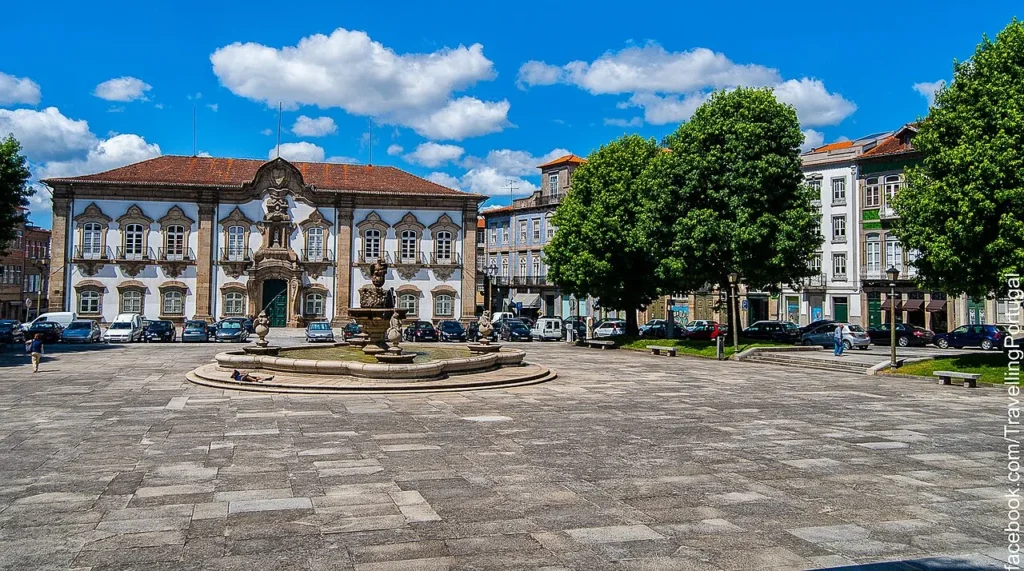
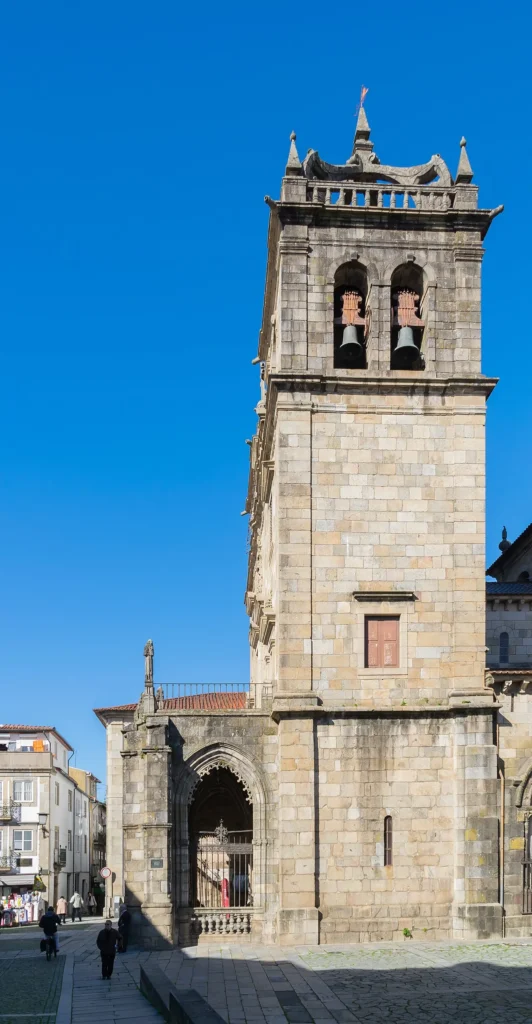
This position was significant. Near the cathedral stood the civic and ecclesiastical powers of Braga, including the Paços do Concelho, the archiepiscopal sphere, market activity and the Cabido’s property network. The Judiaria Velha was therefore not marginal in the simple geographic sense. It stood in a privileged but controlled setting, close to Christian authority and dependent on ecclesiastical property structures.
The exact limits of the Judiaria Velha remain uncertain. The strongest interpretation confines it mainly to the northern stretch of Rua da Erva. Documentary references point to houses, adjoining properties, corners of the old Jewish quarter and the presence of Jews who remained there even after the transfer began. This suggests an open and porous quarter, not necessarily a fully gated enclosure.
The first synagogue and the later transfer
The first synagogue of Braga is associated with the western side of the northern stretch of Rua da Erva, near the Praça da Cidade. The surviving references describe it modestly as “houses”, suggesting a simple building without prominent exterior architecture. This fits the wider pattern of many medieval Portuguese synagogues, which were often adapted domestic structures rather than monumental purpose-built buildings.
In 1466 and 1467, the community was moved to the Judiaria Nova, linked to the area later known as Rua de Santo António das Travessas. This transfer did not erase the older quarter from memory. On the contrary, the name Judiaria Velha continued to function as a documentary and topographical reference after the Jewish community’s relocation.
The Judiaria Velha de Braga is therefore a key site for understanding Jewish life in a city dominated by the cathedral and its Cabido. It records a transition from dispersed residence to communal concentration, and then to relocation. It also shows that Jewish urban history in Portugal is often preserved through leases, street names and the afterlife of buildings, not only through monuments.
Gallery
Sources & Bibliography
- RIBEIRO, Maria do Carmo. Expressões físicas da inclusão e exclusão dos judeus no urbanismo medieval, a partir do caso de Braga. In Inclusão e Exclusão na Europa Urbana Medieval / Inclusion and Exclusion in Medieval Urban Europe. Local: Lisbon; Castelo de Vide. Editora: Instituto de Estudos Medievais, FCSH-UNL / Câmara Municipal de Castelo de Vide. Ano: 2019
- CÂMARA MUNICIPAL DE BRAGA. Mapas e Roteiros. Roteiro Judaico em Braga. Local: Braga. Editora: Câmara Municipal de Braga. Ano: n.d
- MARQUES, José. A contenda do cabido com os judeus de Braga, na segunda metade do século XV. Revista Altitude. Ano: 1981
- WESTERN SEPHARDIC DIASPORA ROADMAP. Cartório do Cabido da Sé de Braga. Ano: n.d
Article researched and curated by Jew Where.
The Jew Where project is collaborative. Do you have additional information, found an inaccuracy, or have historical photos of this location? Contact our team.
Community notes
Comments
Logged-in visitors can submit comments for moderation before they appear publicly.
No comments yet.
Log in to leave a comment. Go to Account.