

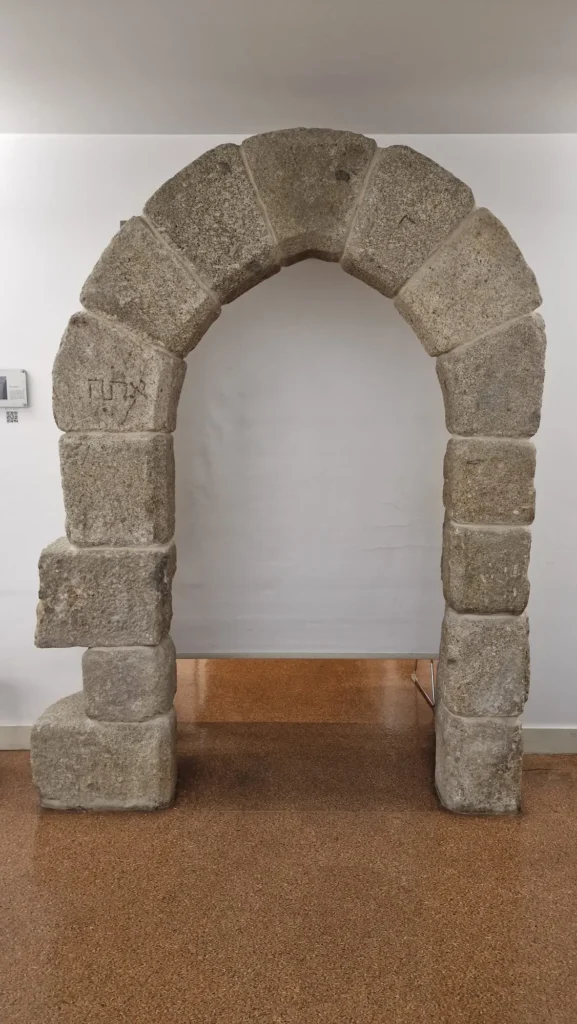
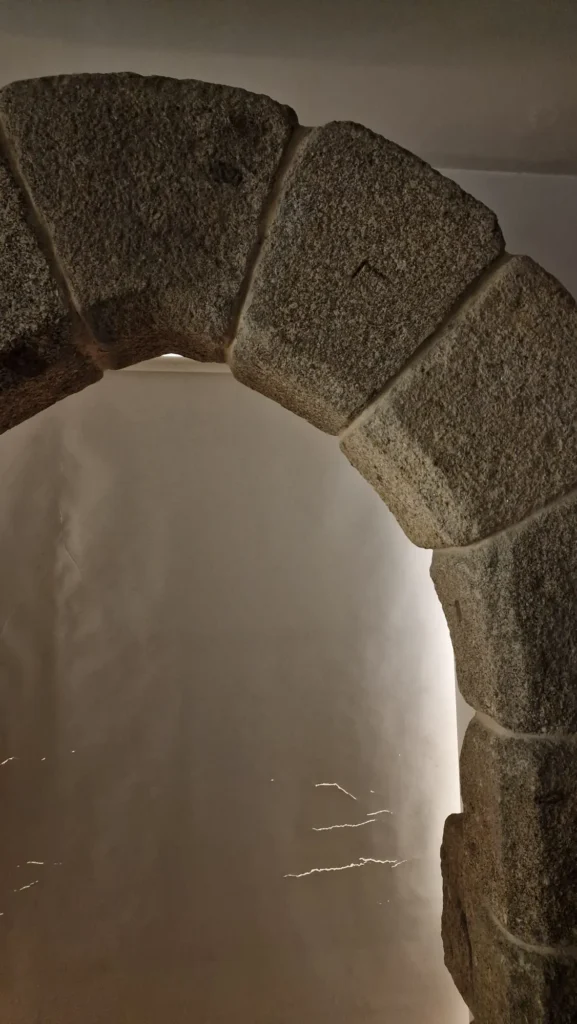
The Hebrew inscription of Braga is one of the rarest material traces of medieval Jewish presence in the city. It consists of a small Hebrew carving made up of only three letters, engraved on a granite voussoir reused within a Gothic arch preserved inside the building historically known as Casa Grande, the former District Hostel, located on Rua de Santo António das Travessas, within the area of the Judiaria Nova.
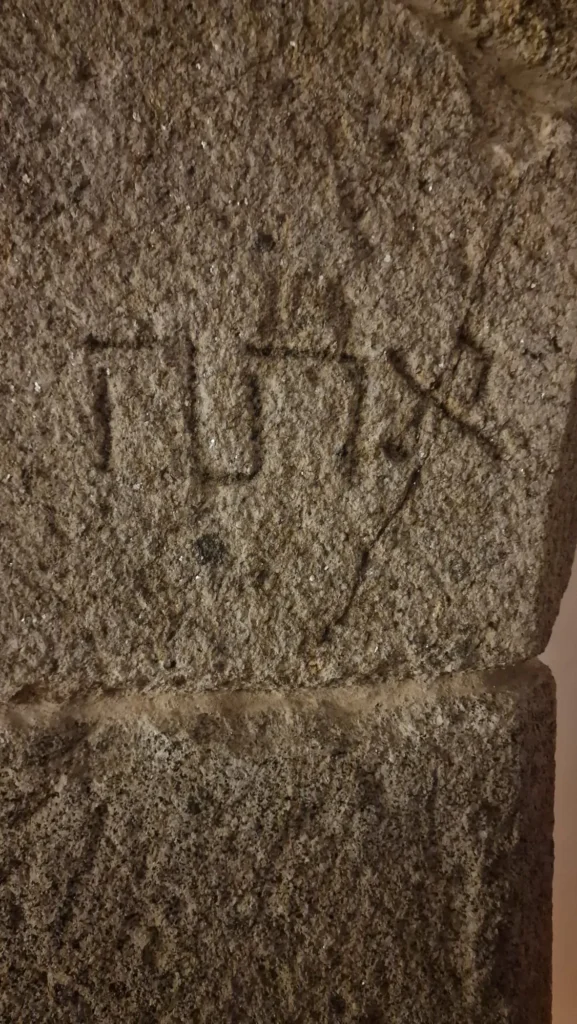
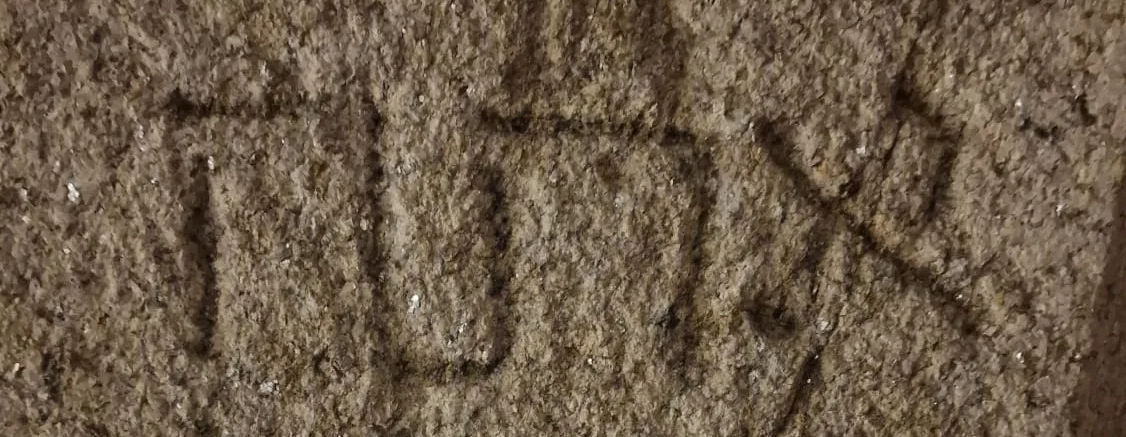
The inscription was identified in March 1981 by historian Eduardo Pires de Oliveira during works carried out in the building and later examined by several scholars. The letters, written in square Hebrew script, are alef, tav, and he (א ת ה). Due to its extreme brevity, the inscription’s exact meaning remains uncertain. Scholarly analysis raises a key question: whether the stone was carved for that specific location or reused from an earlier architectural context, a hypothesis considered likely.
Despite these uncertainties, the inscription is widely regarded as medieval and not a modern forgery. Its importance lies precisely in its modest scale and its urban context. While it does not conclusively identify the location of a synagogue, it stands as a rare epigraphic trace of Jewish life in Braga and strengthens the historical identification of the Judiaria Nova on Rua de Santo António das Travessas.
This fragment exemplifies how Jewish history in Portugal often survives through minimal physical traces, demanding careful reading, interpretative restraint, and respect for material evidence.
Gallery
Sources & Bibliography
- CÂMARA MUNICIPAL DE BRAGA. Edifícios (dois), na Rua de Santo António das Travessas. Local: Braga. Editora: Câmara Municipal de Braga. Ano: n.d
- RIBEIRO, Maria do Carmo. Expressões físicas da inclusão e exclusão dos judeus no urbanismo medieval, a partir do caso de Braga. In: ANDRADE, Amélia Aguiar; TENTE, Catarina; SILVA, Gonçalo Melo da; PRATA, Sara, eds. Inclusão e exclusão na Europa urbana medieval. Local: Lisboa. Editora: IEM - Instituto de Estudos Medievais / Câmara Municipal de Castelo de Vide. Ano: 2019
Article researched and curated by Jew Where.
The Jew Where project is collaborative. Do you have additional information, found an inaccuracy, or have historical photos of this location? Contact our team.
Community notes
Comments
Logged-in visitors can submit comments for moderation before they appear publicly.
No comments yet.
Log in to leave a comment. Go to Account.