
Congregation Rodeph Sholom is one of the historic Jewish congregations of New York City. Founded in 1842 on Attorney Street, in Manhattan’s Lower East Side, it began as a German-speaking Jewish congregation created by immigrants who needed more than a place of prayer. Its first charter included worship, care for the sick, support for new immigrants, education for children, and the purchase of cemetery land. From the beginning, Rodeph Sholom was both a synagogue and a communal structure.
Movement Through Jewish New York
Its history follows the movement of Jewish life in New York. The congregation moved from Attorney Street to Clinton Street, later to Lexington Avenue and 63rd Street, and eventually to the Upper West Side. These changes reflect the wider transformation of Jewish New York, from immigrant neighborhoods downtown to established communities further uptown.
Religious Development
Religiously, Rodeph Sholom also changed with American Judaism. It began in an Orthodox framework, later adopted a more modern service under Rabbi Aaron Wise, and became formally connected to Reform Judaism in the early twentieth century. In 1901, it joined the Union of American Hebrew Congregations, now the Union for Reform Judaism, and in 1924 it adopted the Union Prayer Book.
The Present Synagogue Building
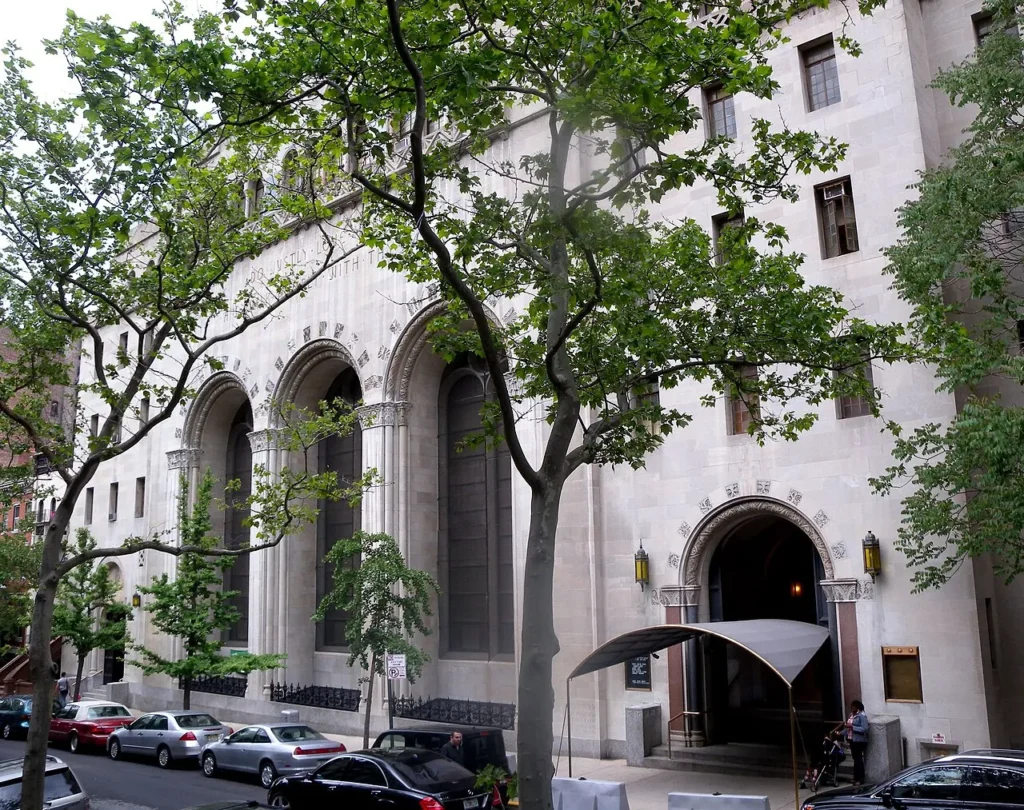
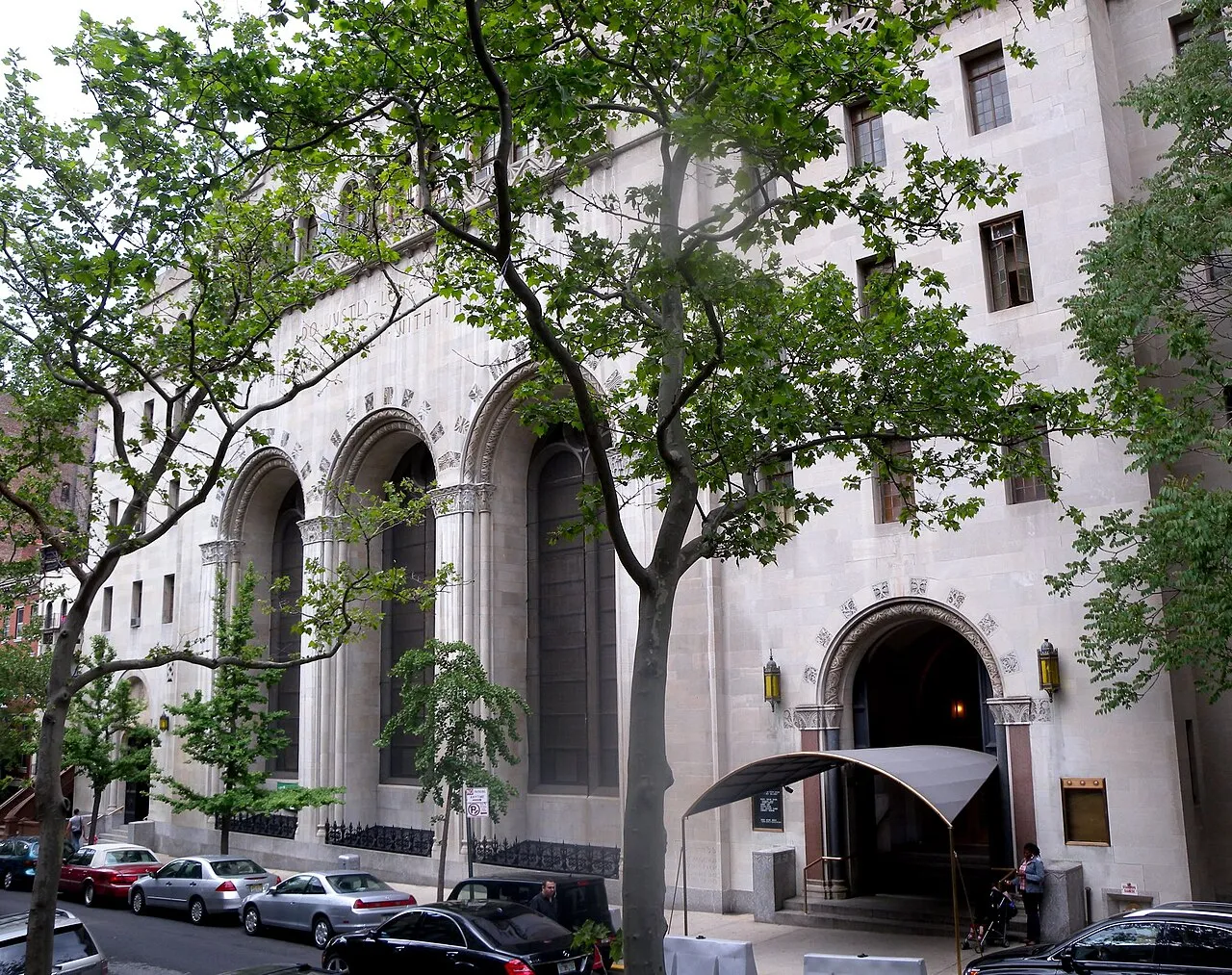
The congregation’s present synagogue, at 7 West 83rd Street, was built between 1928 and 1930 and designed by Charles Bradford Meyers. The New York City Landmarks Preservation Commission describes the building as Neo-Romanesque and Byzantine in character, with limestone, granite, stained glass, ironwork, and large arched forms. Dedicated in 1930, the building gave Rodeph Sholom a monumental presence on the Upper West Side while preserving its role as an active center of Jewish communal life.
Education
Education became one of its strongest contributions. Rodeph Sholom supported Jewish schooling from the nineteenth century and, in 1970, founded what the congregation identifies as the first Reform Jewish day school in North America, today Rodeph Sholom School. This made education a central part of its identity, not only an extension of synagogue life.
Memory and the Czech Memorial Torah Scroll
The congregation also carries a significant memorial responsibility through its Czech Memorial Torah Scroll, one of the Torah scrolls rescued after the destruction of Jewish communities in Bohemia and Moravia during the Shoah. Although its exact town of origin is unknown, the scroll stands as a material witness to destroyed communities and as a living object of memory.
Rodeph Sholom Today
Today, Congregation Rodeph Sholom remains an active Reform synagogue, school, and community on Manhattan’s Upper West Side. Its importance lies in the continuity between immigrant Jewish history, religious adaptation, education, social responsibility, memory, and contemporary Jewish life.
Gallery
Videos
Sources & Bibliography
- Congregation Rodeph Sholom. History. n.d
- Congregation Rodeph Sholom. About Us. n.d
- Congregation Rodeph Sholom. Czech Memorial Torah Scroll. n.d
- Congregation Rodeph Sholom. Union Field Cemetery. n.d
- Union for Reform Judaism. Congregation Rodeph Sholom, New York, NY. n.d
- Memorial Scrolls Trust. Our Story. n.d
- Ackman & Ziff Genealogy Institute at the Center for Jewish History. Rodeph Sholom of New York, Congregation. n.d
Article researched and curated by Jew Where.
The Jew Where project is collaborative. Do you have additional information, found an inaccuracy, or have historical photos of this location? Contact our team.
Community notes
Comments
Logged-in visitors can submit comments for moderation before they appear publicly.
No comments yet.
Log in to leave a comment. Go to Account.