The Judiaria da Pedreira, literally the “Jewry of the Quarry,” designates a small Jewish residential nucleus associated with the medieval toponym Pedreira, in the western outskirts of Lisbon’s old urban core. In modern terms, scholarship places this nucleus in the area between Rua Garrett and the Convento do Carmo, close to today’s Largo do Carmo, within the Baixa-Chiado and Bairro Alto hillside.
Pedreira was a peri-urban zone that began to urbanize more intensively from the 13th century onward, tied to Lisbon’s westward expansion beyond the valley of the Baixa. It combined rural properties (vineyards and fields) with new construction promoted by major institutional actors and, at key moments, by the Crown itself, including a short-lived association with facilities for the Estudo Geral (the medieval university) in Lisbon.
Within this setting, the “Pedreira nucleus” emerges in the reign of King D. Dinis (1279–1325). A focused study of Dinis-era documentation describes Jewish residence there as a short-lived enclave, dated roughly to 1303–1317, created and then extinguished under royal initiative. The same research links the nucleus to a high-status Jewish family (the Navarro), noting that the Crown granted them houses in Pedreira and that this was not a typical dense “walled” judiaria, but rather an extramural, privileged cluster near royal properties and close to the city’s commercial heart.
A crucial nuance is terminological. Contemporary records do not consistently label Pedreira as a formal “judiaria”; instead, they preserve phrases such as “the rents of the Jews of Pedreira,” alongside references to other recognized Jewish quarters. On this basis, the Pedreira enclave is interpreted as an elite Jewish nucleus, later remembered and described as the Judiaria da Pedreira in historiography.
In 1317, D. Dinis donated the houses and assets in Pedreira that had been associated with Jews to Micer Manuel Pessanha, the Genoese admiral tied to the organization of the Portuguese royal navy. This donation is treated as a decisive marker for the end of the Jewish residential nucleus in Pedreira.
The Pedreira enclave should be understood within the broader pattern of multiple Jewish quarters in medieval Lisbon, which were not necessarily all contemporaneous. A scholarly overview of Lisbon’s medieval Jewish geography lists several quarters and explicitly places the Judiaria da Pedreira near Largo do Carmo, noting its extinction under D. Dinis in 1317, while other quarters, such as the Judiaria Velha/Grande, the Taracenas (Judiaria Nova/Pequena), and later Alfama, structured Jewish residence in different phases.
Today, nothing above ground can be securely identified as a surviving “Judiaria da Pedreira.” Its significance is documentary and urban-historical: a case where royal planning, property policy, and the social stratification of Lisbon’s Jewish population intersected in a specific landscape that later became one of the city’s most emblematic areas, around the Carmo and Chiado.
Royal Hospital of All Saints Site
The Royal Hospital of All Saints was Lisbon’s main early modern hospital complex, built on the Rossio, in the area that later became Praça da Figueira. Founded under King João II and inaugurated under King Manuel I, it concentrated assistance and medical care in a single large institution, replacing a dispersed network of smaller hospitals.
Its link to Jewish history is documented in written sources connected to the confiscation of Jewish communal property after the expulsion and forced conversion. In a widely cited study, historian Amélia Aguiar Andrade states that assets from Lisbon’s synagogues and communal buildings were used to support the hospital works, and adds a specific claim: tombstones from the Jewish cemetery of Santa Justa were redirected to the hospital’s construction. The same passage records that the cemetery land was donated to the Lisbon city council in 1497.
This detail is important, but it remains documentary rather than archaeologically demonstrated. Urban excavations have revealed portions of the hospital’s remains in the Praça da Figueira area, yet published reports have not documented the identification of Hebrew-inscribed tombstones from Santa Justa within surviving foundations.
The Palace of the Inquisition (Estaus Palace)
The Palace of the Lisbon Inquisition, historically known as the Palácio dos Estaus, stood on the northern edge of the Rossio, Lisbon’s principal civic square. From the mid 16th century onward, this building became the central seat of the Tribunal do Santo Ofício in the capital, embodying the institutional and symbolic power of the Portuguese Inquisition over the city and the kingdom.
Originally erected in the late 15th century as a royal guesthouse to receive foreign dignitaries, the Estaus palace was appropriated by the Inquisition shortly after the formal establishment of the tribunal in Portugal in 1536. Its location was deliberate. Positioned directly on Rossio, the heart of Lisbon’s political, judicial, and commercial life, the palace anchored inquisitorial authority within the most visible and frequented urban space.
Within its walls operated the full bureaucratic machinery of persecution: interrogation chambers, offices of notaries and inquisitors, archives, and detention areas for prisoners awaiting trial. Many of those detained were New Christians of Jewish origin, accused of practicing Judaism in secret. For Lisbon’s converso population, the palace was not an abstract symbol but a concrete destination, often marking the beginning of imprisonment, confiscation of property, exile, or death.
The palace was also directly connected to the public ritual of punishment. Autos da fé were staged in Rossio itself, transforming the square into a theater of fear and discipline. Prisoners were escorted from the palace to the scaffold before large crowds, reinforcing inquisitorial power through spectacle and collective intimidation. The proximity between tribunal, prison, and execution ground created a continuous geography of repression within the city.
The Lisbon Inquisition operated from the Estaus palace for more than two centuries. Its authority extended beyond religious control, deeply shaping social behavior, economic networks, and family histories, particularly among descendants of medieval Portuguese Jewry. Even after the gradual decline of inquisitorial activity in the 18th century, the building remained charged with the memory of surveillance and coercion.
The devastating earthquake of 1755 severely damaged the palace. Although the structure was partially rebuilt, its function changed, and the Inquisition itself was definitively abolished in 1821. The physical disappearance of the palace over time contrasts sharply with the endurance of its historical significance. Today, Rossio bears no visible architectural trace of the inquisitorial complex, yet the site remains one of the most important locations for understanding the mechanisms of persecution and the lived experience of Jews and New Christians in early modern Lisbon.
Today, the site formerly occupied by the Palácio dos Estaus is home to the Teatro Nacional D. Maria II, inaugurated in 1846. Built after the disappearance of the inquisitorial palace, the theatre represents a profound symbolic reversal of the place’s historical function. Where the Lisbon Inquisition once operated its tribunals, prisons, and public rituals of punishment, the space is now dedicated to dramatic arts and civic culture. Although no visible trace of the Inquisition remains in the building itself, the continuity of location on the northern edge of Rossio preserves the site as a key reference point for understanding the layered history of repression, memory, and transformation in Lisbon’s urban landscape.
Autos-da-Fé at Praça do Comércio
Before becoming Lisbon’s monumental waterfront square, Praça do Comércio was known as Terreiro do Paço, the political and ceremonial heart of the Portuguese kingdom. From the late 16th century until the mid-18th century, this open space was one of the principal stages for autos-da-fé, the public rituals organized by the Portuguese Inquisition to pronounce sentences against those accused of heresy.
These ceremonies were not marginal events. They were carefully choreographed spectacles involving royal authorities, ecclesiastical institutions, and large crowds. Their public nature was intentional: punishment, confession, and reconciliation were transformed into instruments of collective instruction and fear.
For New Christians, many of them of Jewish origin or descendants of forcibly converted Jews, the Terreiro do Paço became a space of exposure and humiliation, where private belief was violently transformed into public accusation.
The Ritual of the Auto-da-fé
An auto-da-fé typically unfolded over several stages. Prisoners were brought from inquisitorial jails to the square, often wearing penitential garments such as the sanbenito, marked with symbols indicating their alleged crimes. Sermons were preached, sentences were read aloud, and distinctions were made between those “reconciled” to the Church and those handed over to secular authorities for execution.
While executions often took place outside the city walls, the Terreiro do Paço was where the social verdict was delivered. The square functioned as a theater of power, binding religious orthodoxy to royal authority in the most visible urban setting of Lisbon.
Jewish History and the Inquisition in Lisbon
For the Jewish and converso population, the autos-da-fé held at Terreiro do Paço were a constant reminder of surveillance and vulnerability. Families could see relatives publicly accused; entire social networks were destabilized. Even those not directly prosecuted lived under the pressure of denunciation, confiscation of property, and social exclusion.
This site thus forms part of the broader geography of persecution in Lisbon, connecting inquisitorial prisons, confiscated houses, forced migrations, and exile routes that extended far beyond Portugal.
Transformation of the Space
The devastating earthquake of 1755 destroyed much of the Ribeira Palace that framed the Terreiro do Paço. In its reconstruction, the square was reimagined as Praça do Comércio, symbol of mercantile power and imperial renewal. This transformation physically erased many architectural traces of the inquisitorial past, but not its historical weight.
Today, the square is associated with openness, light, and the Tagus River. Yet beneath its rational Pombaline design lies the memory of a space where justice was staged as spectacle and intolerance was normalized through ritual.
Cabo Ruivo Seaplane Base
Opened as a seaplane gateway on the Tagus waterfront, Cabo Ruivo was Lisbon’s “river airport” in the era of long-range flying boats. Pan American established a provisional base here in 1938, and the site became a strategic point for intercontinental air travel, especially during the Second World War, when Lisbon functioned as an entry and escape corridor in neutral Portugal.
The first scheduled commercial passenger flight arrived on 29 June 1939, when Pan Am’s Boeing 314 “Dixie Clipper” reached Cabo Ruivo after departing Port Washington, New York, continuing onward toward Marseille as part of the transatlantic route.
Built context and location
In 1942, the Portuguese government decided to create a proper air-marine base and structured the airport around the Doca dos Olivais. To link the seaplane airport with the land airport at Portela, a major road connection was built, originally called Avenida Entre-os-Aeroportos, today Avenida de Berlim.
Wartime threshold: what can, and cannot, be counted
A precise number of “refugees who entered by plane” is difficult to establish from the published record because most statistics refer to total passenger traffic rather than refugee status.
What can be quantified is the scale of the air-sea entry channel. A detailed study of Lisbon’s wartime travel economy records that, by the end of 1939, more than thirty-nine transatlantic flying boats had already brought 643 passengers to Cabo Ruivo, and that in the six following years another 16,000 passengers still used this means of transport to disembark in Lisbon. These figures describe passengers, not exclusively refugees, but they define the order of magnitude of the route that included refugee travel.
Refugee entry and stories tied to the Clipper route
Contemporary historical writing describes Pan American’s Clipper service as an emblematic escape vehicle for those who could afford it, a “luxurious seaplane” flying twice weekly between Lisbon and New York during the war years.
Photographic documentation from the period, held in archives and community collections, records Cabo Ruivo as a waterfront threshold of wartime mobility: arrivals and departures by flying boat, passengers with luggage and documents, uniforms and ground crews, waiting areas, and the choreography of transit along the Tagus, in an airport that no longer functions as an airport but remains identifiable as a place.
Critical event: the Yankee Clipper crash (1943)
Cabo Ruivo’s history also includes disaster. On 22 February 1943, Pan Am’s Boeing 314 “Yankee Clipper” crashed while attempting to land on the River Tagus in Lisbon, killing 24 of the 39 people on board, with 15 survivors recorded in accident documentation.
Afterlife of the site
As land-based aviation became dominant after the war, the flying-boat era ended. Cabo Ruivo’s seaplane operations were discontinued in the late 1950s (often given as 1958/59), and the waterfront area was later reshaped through major redevelopment associated with Expo ’98 and today’s Parque das Nações.
Jewish Inscriptions in the Carmo Museum
The Jewish inscriptions preserved in the Museu Arqueológico do Carmo form one of the most important groups of Hebrew epigraphy in Portugal. The museum was founded in 1864 by the Associação dos Arqueólogos Portugueses and is installed in the ruins of the former Carmo Church, in central Lisbon. Within its collection, the key Jewish pieces are two funerary stelae from Espiche, near Lagos, and the monumental inscription from the former Synagogue of Monchique, in Porto.
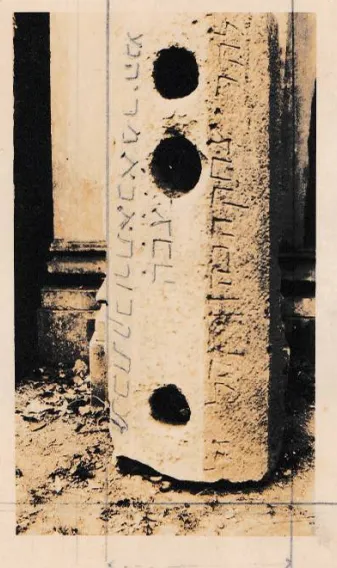
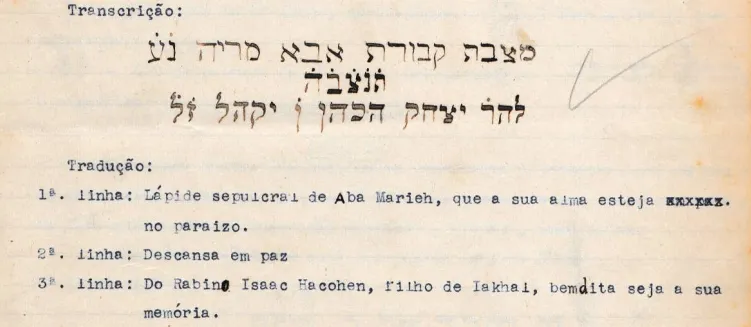
Espiche Stele, Aba Marieh and Rabbi Isaac HaCohen
Catalogue no. 3877. Provenance: Espiche, near Lagos. Entered the museum in 1874.
Biblioteca Samuel SchwarzBiblioteca Samuel Schwarz
This is a prismatic funerary stele with inscriptions on three faces. It records two burials at different moments: Aba Marieh and Rabbi Isaac HaCohen, son of Iakhai. The text preserves standard Hebrew funerary formulas and shows that the same stone was reused for two individuals. It is one of the clearest Jewish funerary inscriptions from medieval Portugal preserved in a museum collection.
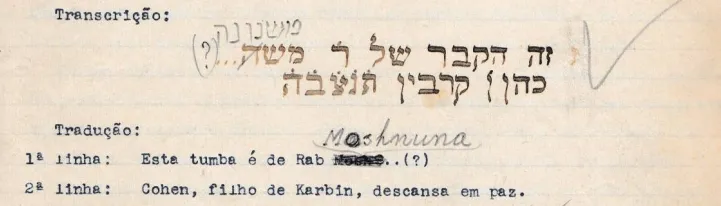
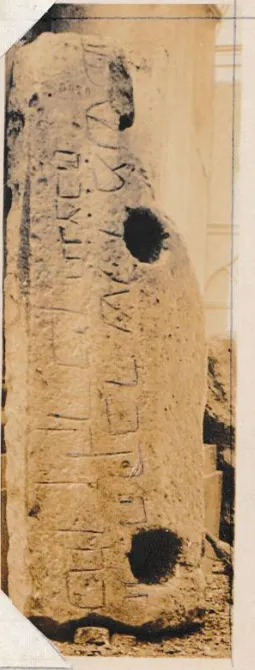
Espiche Stele, Rab Moshe and Cohen son of Karbin
Catalogue no. 3878. Provenance: Espiche, near Lagos. Entered the museum in 1874.
Biblioteca Samuel SchwarzBiblioteca Samuel Schwarz
This second Espiche stone is also funerary. It is a prismatic stele with a damaged inscription, which makes the reading incomplete. The surviving text refers to a rabbi whose name begins with Moshe and to a Cohen, son of Karbin, followed by a funerary formula. Even in its damaged state, the stone remains an important witness to Hebrew burial epigraphy in the Algarve.
Monchique Synagogue Inscription
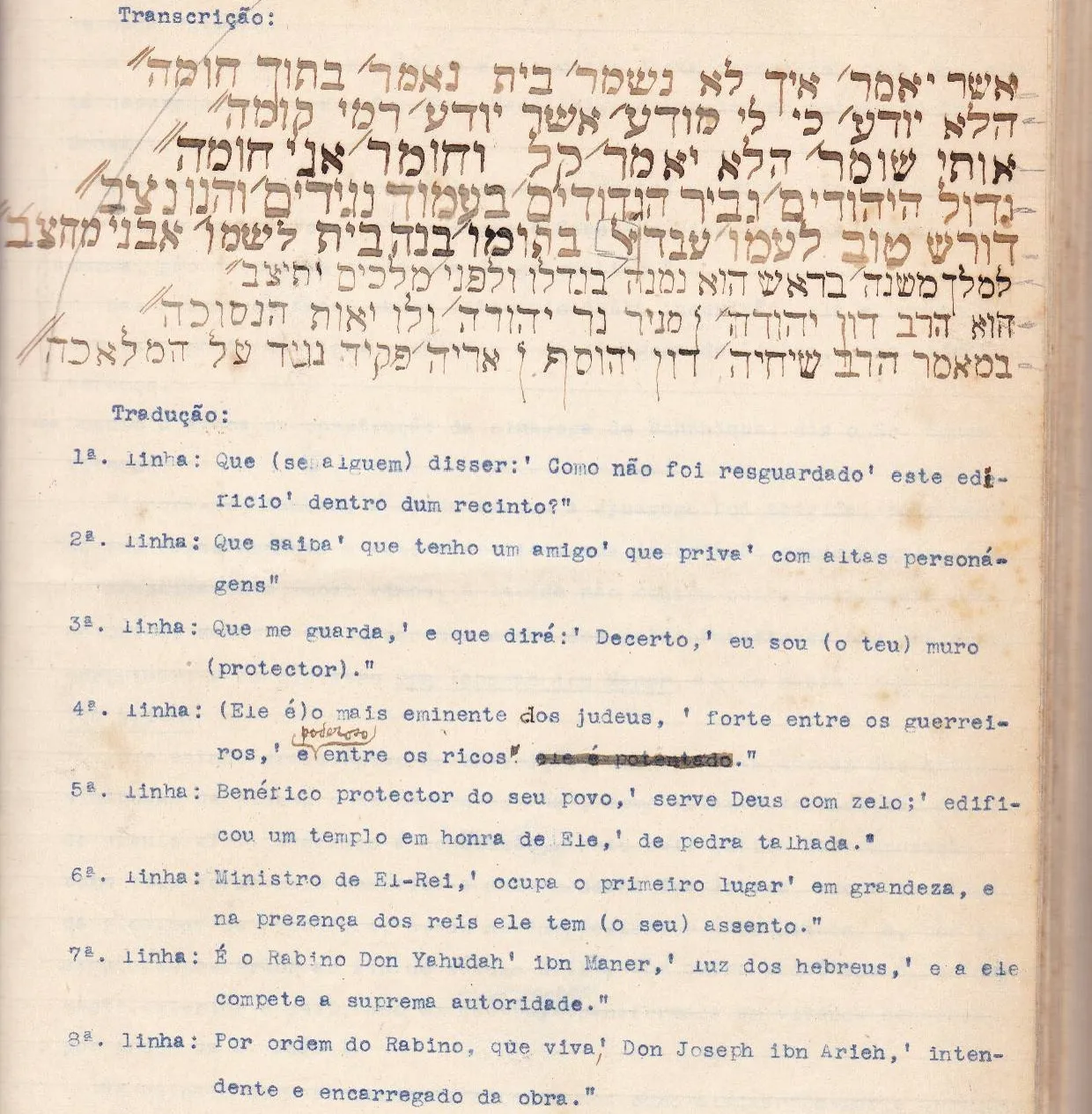
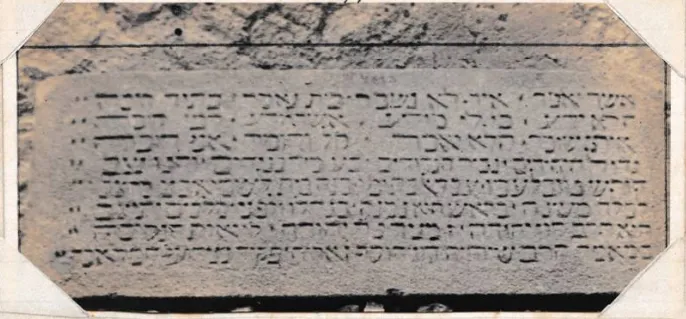
Catalogue no. 2313. Provenance: former Synagogue of Monchique, Porto. Transferred to the museum on 3 February 1875. Material: granite. Dimensions: 1.54 m x 0.63 m.
Biblioteca Samuel SchwarzBiblioteca Samuel Schwarz
This is the most important Jewish inscription in the Carmo Museum. Unlike the Espiche stones, it is not funerary but communal. It comes from the former Synagogue of Monchique in Porto and preserves a commemorative synagogue text. Its significance lies in the fact that it is a rare surviving inscription directly connected to medieval Jewish institutional life in Portugal.